


Page 286 - (DK) Smithsinian - Military History: The Definitive Visual Guide to the Objects of Warfare
P. 286
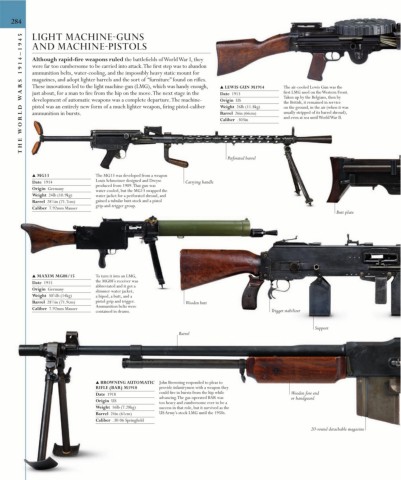
284    LIGHT MACHINE-GUNS

         1914–1945  AND MACHINE-PISTOLS


            Although rapid-fire weapons ruled the battlefields of World War I, they
            were far too cumbersome to be carried into attack. The first step was to abandon

         ARS   ammunition belts, water-cooling, and the impossibly heavy static mount for   ▲ LEWIS GUN M1914  The air-cooled Lewis Gun was the
            magazines, and adopt lighter barrels and the sort of  “furniture” found on rifles.
            These innovations led to the light machine-gun (LMG), which was handy enough,
                                                                                                      first LMG used on the Western Front.
            just about, for a man to fire from the hip on the move. The next stage in the
                                                                               Date  1913
                                                                                                      Taken up by the Belgians, then by
         ORLD W  development of automatic weapons was a complete departure. The machine-  Origin  US  the British, it remained in service
            pistol was an entirely new form of a much lighter weapon, firing pistol-caliber
                                                                               Weight  26lb (11.8kg)
                                                                                                      on the ground, in the air (when it was
                                                                                                      usually stripped of its barrel shroud),
            ammunition in bursts.
                                                                               Barrel  26in (66cm)
                                                                                                      and even at sea until World War II.
                                                                               Caliber  .303in
         THE W
                                                                                  Perforated barrel

            ▲ MG13                 The MG13 was developed from a weapon
            Date  1914             Louis Schmeisser designed and Dreyse   Carrying handle
                                   produced from 1909. That gun was
            Origin  Germany
                                   water-cooled, but the MG13 swapped the
            Weight  24lb (10.9kg)  water jacket for a perforated shroud, and
            Barrel  28 ⁄4in (71.7cm)  gained a tubular butt stock and a pistol
                   1
                                   grip-and-trigger group.
            Caliber  7.92mm Mauser
                                                                                                                         Butt plate


            ▲ MAXIM MG08/15        To turn it into an LMG,
            Date  1915             the MG08’s receiver was
                                   abbreviated and it got a
            Origin  Germany
                                   slimmer water jacket,
                    3
            Weight  30 ⁄4lb (14kg)  a bipod, a butt, and a
            Barrel  28 ⁄2in (71.9cm)  pistol grip and trigger.     Wooden butt
                   1
                                   Ammunition belts were
            Caliber  7.92mm Mauser
                                   contained in drums.                                            Trigger stabilizer
                                                                                                                 Support
                                                                 Barrel


                                   ▲ BROWNING AUTOMATIC  John Browning responded to pleas to
                                   RIFLE (BAR) M1918      provide infantrymen with a weapon they
                                   Date  1918             could fire in bursts from the hip while        Wooden fore end
                                                          advancing. The gas-operated BAR was            or handguard
                                   Origin  US             too heavy and cumbersome ever to be a
                                   Weight  16lb (7.28kg)  success in that role, but it survived as the
                                   Barrel  24in (61cm)    US Army’s stock LMG until the 1950s.
                                   Caliber  .30-06 Springfield
                                                                                                                20-round detachable magazine

