


Page 34 - (DK) Smithsinian - Military History: The Definitive Visual Guide to the Objects of Warfare
P. 34
32

         CE  KEY DEVELOPMENT                                                                                KEY FIGURE
                                                                                                            JULIUS CAESAR
         O 500  THE ROMAN WAR MACHINE                                                                       100–44bce

                                                                                                            Roman general Julius Caesar
                                                                                                            secured his reputation in a series
         ORDS   T  Until the collapse of the western Roman empire in the 5th century CE, the Roman          of campaigns in Gaul, from 58 to
                                                                                                            50bce, securing large new provinces
            legions formed the most formidable army of the Ancient World. Primarily an
                                                                                                            for Rome. Dogged and tactically
            infantry force, it underwent a number of changes during its time of dominance.
                                                                                                            adept, Caesar ruthlessly suppressed
                                                                                                                  tribes who opposed
                                                                                                                      him, such as the
         AND SW  The early Roman army was a citizen militia, drawn   Drawn up in these three lines—each divided       Belgae and Nervii,
            mainly from the wealthier classes. It owed its early
                                                                                                                       and was made
                                                           into 10 maniples (units) of around 150 men—
                                                                                                                       dictator for
            successes to Rome’s ability to conscript large numbers  the legion fought in much the same way as many
                                                                                                                        life. Soon after,
            of recruits in times of war, and to its formidable
                                                           ancient armies. Supporting cavalry (equites) and
                                                                                                                        however, he was
                                                                                                                        assassinated.
         TS   tactical organization and training, which were far   light infantry (velites) would attempt to turn the   ◀ At the time of
            superior to those of its Italian enemies. The early
                                                           enemy flank, while the heavy infantry tried to
            legions had three categories of heavy infantry—the
                                                           breach their opponents’ line. Few armies could
                                                                                                                      his assassination,
         CHARIO  the best-quality troops, and the triarii, the veterans.  legion suffered major setbacks when faced with   planning further
                                                                                                                      Julius Caesar was
            hastati, who were the least experienced, the principes,  match the Romans in number or skill, but the
                                                                                                                      military conquests, of
                                                                                                                      the Dacians and the
                                                           the tactical genius of the Carthaginian general
            The hastati and principes were armed with heavy
                                                                                                                      Parthians.
            javelins ( pila), whereas the triarii had thrusting
                                                           Hannibal, during the Second Punic War.
            spears (hastae). The legionaries were protected by
            bronze helmets and semi-cylindrical body shields   THE MARIAN REFORMS
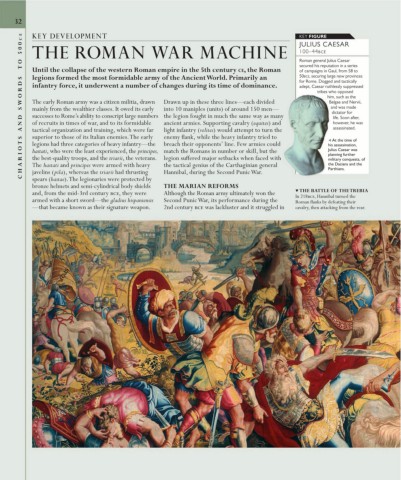
            and, from the mid-3rd century bce, they were   Although the Roman army ultimately won the     ▼ THE BATTLE OF  THE TREBIA
                                                                                                          In 218bce, Hannibal turned the
            armed with a short sword—the gladius hispaniensis   Second Punic War, its performance during the    Roman flanks by defeating their
            —that became known as their signature weapon.   2nd century bce was lackluster and it struggled in   cavalry, then attacking from the rear.

