


Page 330 - (DK) Smithsinian - Military History: The Definitive Visual Guide to the Objects of Warfare
P. 330
328    CAPITAL SHIPS

         1914–1945  Although the term “capital ship” was not actually defined until the                                 Radio antenna


            1920s, by the outbreak of  World War I it was already being applied to
            the most powerful craft in the fleet: battleships and battlecruisers, which

            seemed to dominate the field of naval warfare during World War I, but in
         ARS   sacrificed armor for speed as a means of protecting themselves. Battleships
            fact the expected large-scale battle between the German and British fleets
            did not materialize. After the war, they bore the brunt of internationally
            mandated cuts, but their heyday was already past in any case. In the early
         ORLD W  stages of  World War II they proved themselves sickeningly vulnerable   Gunnery spotting
            to air attack, and the pride-of-place they once enjoyed passed to
            the aircraft carrier.
                                                                                             position
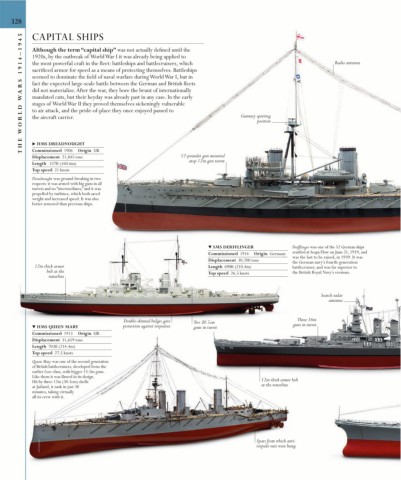
          THE W  ▶ HMS DREADNOUGHT


            Commissioned  1906     Origin  UK
            Displacement  21,845 tons                            12-pounder gun mounted
                                                                    atop 12in gun turret
            Length   527ft (160.6m)
            Top speed  21 knots
            Dreadnought was ground-breaking in two
            respects: it was armed with big guns in all
            turrets and no “intermediates,” and it was
            propelled by turbines, which both saved
            weight and increased speed. It was also
            better armored than previous ships.


                                                                           ▼ SMS DERFFLINGER             Derfflinger was one of the 52 German ships
                                                                           Commissioned  1914     Origin  Germany  scuttled at Scapa Flow on June 21, 1919, and
                                                                                                         was the last to be raised, in 1939. It was
                                                                           Displacement  30,700 tons     the German navy’s fourth-generation
             12in thick armor                                              Length  690ft (210.4m)        battlecruiser, and was far superior to
                  belt at the                                              Top speed  26.5 knots         the British Royal Navy’s versions.
                  waterline


                                                                                                                   Search radar
                                                                                                                      antenna


                                             Double-skinned bulges gave     Two 30.5cm                     Three 16in
            ▼ HMS QUEEN MARY                 protection against torpedoes  guns in turret                guns in turret
            Commissioned  1913     Origin  UK
            Displacement  31,659 tons
            Length  703ft (214.4m)
            Top speed  27.5 knots
            Queen Mary was one of the second generation
            of British battlecruisers, developed from the
            earlier Lion-class, with bigger 13.5in guns.
            Like them it was flawed in its design.
            Hit by three 12in (30.5cm) shells                                                 12in thick armor belt
            at Jutland, it sank in just 38                                                    at the waterline
            minutes, taking virtually
            all its crew with it.


                                                                                            Spars from which anti-
                                                                                            torpedo nets were hung

