


Page 329 - (DK) Smithsinian - Military History: The Definitive Visual Guide to the Objects of Warfare
P. 329
327

                                                                                                          ◀ LOADING A TORPEDO
            at the start of the war, until the technique of                                               The cramped conditions on     BA
            degaussing ship’s hulls (reducing their magnetism)                                            World War II submarines made
            was introduced.                                                                               loading torpedoes in the torpedo
              Meanwhile, U-boats, coordinated by radio and                                                tubes extremely difficult. On German   TTLES
            with improved range, were even more destructive                                               U-boats—as with British submarines
                                                                                                          —the torpedo room also served as
            to merchant shipping than they had been in World                                              living accommodation.         A
            War I. A combination of tactical and technological
            innovations were employed to meet this threat:
            these included improved radar on convoy escort
            ships, and high-frequency radio direction-finding
            equipment (“huff-duff”).                                                                                                    T SEA IN  THE  W
              When gun battles between large surface warships
            did occur, victory usually went to the side with
            superior radar and night-fighting equipment, as
            in the fighting between Japanese and American
            fleets around Guadalcanal in 1942, or between the
            British and Italians in the Mediterranean. Eventual
            naval superiority allowed the Allies to mount
            numerous amphibious landings: the largest of                                                                                ORLD  W
            these, at Normandy in June 1944, was supported
            by more than 1,200 warships.                                                                                                ARS


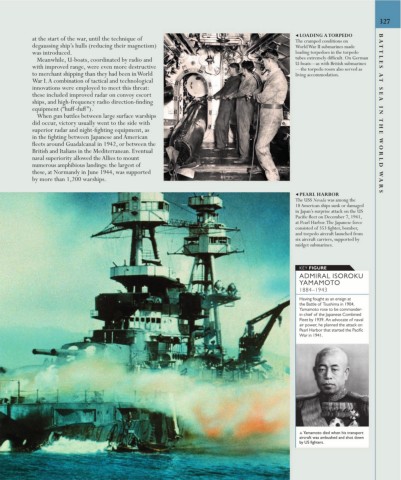
                                                                                                          ◀ PEARL HARBOR
                                                                                                          The USS Nevada was among the
                                                                                                          18 American ships sunk or damaged
                                                                                                          in Japan’s surprise attack on the US
                                                                                                          Pacific fleet on December 7, 1941,
                                                                                                          at Pearl Harbor. The Japanese force
                                                                                                          consisted of 353 fighter, bomber,
                                                                                                          and torpedo aircraft launched from
                                                                                                          six aircraft carriers, supported by
                                                                                                          midget submarines.


                                                                                                            KEY FIGURE
                                                                                                            ADMIRAL ISOROKU
                                                                                                            YAMAMOTO
                                                                                                            1884–1943
                                                                                                            Having fought as an ensign at
                                                                                                            the Battle of Tsushima in 1904,
                                                                                                            Yamamoto rose to be commander-
                                                                                                            in-chief of the Japanese Combined
                                                                                                            Fleet by 1939. An advocate of naval
                                                                                                            air power, he planned the attack on
                                                                                                            Pearl Harbor that started the Pacific
                                                                                                            War in 1941.


                                                                                                            ▲ Yamamoto died when his transport
                                                                                                            aircraft was ambushed and shot down
                                                                                                            by US fighters.

