


Page 325 - (DK) Smithsinian - Military History: The Definitive Visual Guide to the Objects of Warfare
P. 325
323

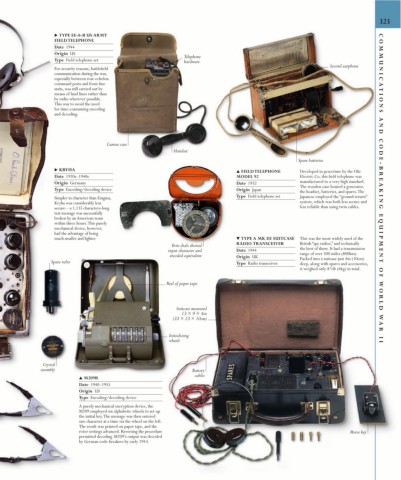
                    ▶ TYPE EE-8-B US ARMY
                    FIELD TELEPHONE
                    Date  1944
                    Origin  US
                                                                  Telephone
                    Type  Field telephone set                                                                                           COMMUNICA
                                                                  hardware
                                                                                                                       Second earphone
                    For security reasons, battlefield
                    communication during the war,
                    especially between rear-echelon
                    command posts and front-line
                    units, was still carried out by
                    means of land lines rather than
                    by radio wherever possible.
                    This was to avoid the need                                                                                          TIONS
                    for time-consuming encoding
                    and decoding.


                                       Canvas case
                                                               Handset
                                                                                                           Spare batteries
                    ▶ KRYHA                                                          ▲ FIELD TELEPHONE      Developed in peacetime by the Oki   AND CODE-BREAKING EQ
                    Date  1920s–1940s                                                MODEL 92               Electric Co, this field telephone was
                    Origin  Germany                                                  Date  1932             manufactured to a very high standard.
                                                                                                            The wooden case housed a generator,
                    Type  Encoding/decoding device                                   Origin  Japan
                                                                                                            the headset, batteries, and spares. The
                    Simpler in character than Enigma,                                Type  Field telephone set  Japanese employed the “ground return”
                    Kryha was considerably less                                                             system, which was both less secure and
                    secure—a 1,135 characters-long                                                          less reliable than using twin cables.
                    test message was successfully
                    broken by an American team
                    within three hours. This purely
                    mechanical device, however,
                    had the advantage of being
                    much smaller and lighter.                                        ▼ TYPE A MK III SUITCASE  This was the most widely used of the
                                                                                     RADIO  TRANSCEIVER     British “spy radios,” and technically
                                                              Twin dials showed
                                                             input character and     Date  1944             the best of them. It had a transmission
                                                             encoded equivalent      Origin  UK             range of over 500 miles (800km).   UIPMENT OF  W
                                                                                                            Packed into a suitcase just 4in (10cm)
                   Spare valve                                                       Type  Radio transceiver  deep, along with spares and accessories,
                                                                                                            it weighed only 8 ⁄4lb (4kg) in total.
                                                                                                                      3
                                                            Reel of paper tape


                                                                Suitcase measured                                                       ORLD  W
                                                                  13 × 9 × 4in
                                                               (33 × 23 × 10cm)


                                                             Initializing                                                               AR II
                                                             wheels


                Crystal
               assembly                                              Battery
                                                                      cables
                             ▲ M209B
                             Date  1940–1955
                             Origin  US
                             Type  Encoding/decoding device
                             A purely mechanical encryption device, the
                             M209 employed six alphabetic wheels to set up
                             the initial key. The message was then entered
                             one character at a time via the wheel on the left.
                             The result was printed on paper tape, and the
                             rotor settings advanced. Reversing the procedure                                                 Morse key
                             permitted decoding. M209’s output was decoded
                             by German code-breakers by early 1943.

