


Page 328 - (DK) Smithsinian - Military History: The Definitive Visual Guide to the Objects of Warfare
P. 328
326                                 KEY DEVELOPMENT

         1914–1945  KEY EVENTS           BATTLES AT SEA IN
              1914–45

              ◼ 1914  In the second month
              of World War I, a single German
                                         THE WORLD WARS
              U-boat in the North Sea sinks
              three British cruisers in one hour.
         ARS   ◼ 1916  Forty-four battleships—  Command of the seas was a vital element in both world wars. The impact
              28 British and 16 German—are
              present at the Battle of Jutland,
                                         of submarines and aircraft created logistical complications, as well as new
              but only a few are sunk in what
         ORLD W  is an indecisive encounter.  dangers, for surface fleets, which were themselves increasingly devoted to
                                         the support of amphibious landings.
              ◼ 1941  The British battleship
              HMS Prince of  Wales and the
                                                                                        World War II brought epic naval conflicts in the
                                         Given the fleets of heavily gunned battleships built
              battle cruiser HMS Repulse, sailing
         THE W  off Malaya without air cover,    in the years leading up to the war, the naval battles   Atlantic, Pacific, and Mediterranean, with
              are sunk by land-based Japanese
                                                                                        the British, German, Italian, American, and
                                         of World War I did not follow expectations: there
              bombers and torpedo aircraft.
                                         was no climactic, pitched battle between the
                                                                                        Japanese navies engaged in fierce combat.
              ◼ 1944  The US Navy deploys
              more than 200 ships against the   German High Seas Fleet and the British Grand   This time the major shock for navies was the
              Japanese at the battle of Leyte    Fleet. On the only occasion when the two met,    vulnerability of even the most powerful warships
              Gulf (see pp.348–49), off the   at Jutland in the summer of 1916, the Germans   to air attack. Within range of hostile aircraft,
              Philippines, one of the largest naval   fled on discovering the full extent of the British   surface ships were dangerously exposed without
              battles in history.
                                         fleet deployed against them, and escaped due to    air cover. German magnetic mines caused havoc
              ◼ 1945  The German Type XXI   a bungled pursuit. In fact, British superiority in
              U-boat enters frontline service.    numbers was simply too great to be challenged,
              It is the first submarine able to
              submerge for long periods, rather   even though German warships proved to have
              than diving occasionally, and can   better range-finding equipment, better protection
              travel at speed underwater.
                                         against shells, and better night-fighting skills.
                                          German surface warships had been expected to
                                         pose a serious threat to British merchant shipping,
                                         but it was the German U-boats that turned out
                                         to be the biggest threat. Having disposed of the
                                         majority of Germany’s warships early in the conflict,
                                         Britain’s Royal Navy were frighteningly vulnerable
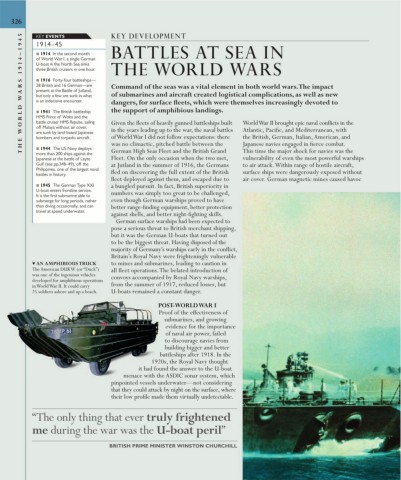
            ▼ AN AMPHIBIOUS TRUCK        to mines and submarines, leading to caution in
            The American DUKW (or “Duck”)   all fleet operations. The belated introduction of
            was one of the ingenious vehicles   convoys accompanied by Royal Navy warships,
            developed for amphibious operations
            in World War II. It could carry    from the summer of 1917, reduced losses, but
            25 soldiers ashore and up a beach.  U-boats remained a constant danger.

                                                         POST-WORLD WAR I
                                                          Proof of the effectiveness of
                                                            submarines, and growing
                                                            evidence for the importance
                                                            of naval air power, failed
                                                            to discourage navies from
                                                            building bigger and better
                                                          battleships after 1918. In the
                                                       1920s, the Royal Navy thought
                                                  it had found the answer to the U-boat
                                             menace with the ASDIC sonar system, which
                                         pinpointed vessels underwater—not considering
                                         that they could attack by night on the surface, where
                                         their low profile made them virtually undetectable.


            “The only thing that ever truly frightened
            me during the war was the U-boat peril”


                                        BRITISH PRIME MINISTER WINSTON CHURCHILL

