


Page 45 - (DK) Smithsinian - Military History: The Definitive Visual Guide to the Objects of Warfare
P. 45
43
have used large catapults to hurl rocks, as well later the Sakas and Hunas. Horse-mounted
as the rathamusala, a chariot fitted with a mace bowmen, these warriors could travel rapidly,
that scythed through the enemy’s ranks. From the enabling them to carry out successful campaigns
early 5th century bce, the empire-building Nanda of harassment against Indian forces of greater
dynasty could deploy armies consisting of 20,000 number. The established Asian powers, with their
cavalry and 200,000 chariots, as well as 3,000 more conventional military tactics, found these ASIAN TRADITIONS
war elephants, which the Greeks encountered for offensives difficult to repel. In China, the Han
the first time when Alexander the Great’s army engaged in a long-running struggle against the
invaded India in 327bce. nomadic Xiongnu people to the northwest,
who several times during the 2nd century bce
HORSEBACK RAIDERS seized control of the strategic Tarim Basin. They
From the 2nd century bce, Indian dynasties lost and many other tribes continued to plague the
territory in the north of the country to Central Chinese along the whole frontier of their empire
Asian nomadic groups such as the Yuezhi, and well into the 5th century ce.
▲ TERRACOTTA ARCHER
“Let your rapidity be that of the wind, your compactness Often aristocratic warriors, archers
formed the elite of Chinese armies,
until the rise of elite infantry and
that of the forest. In raiding and plundering, be like fire” weapons such as the crossbow, which
occurred during the Warring States
period (403–221bce).
SUNZI, THE ART OF WAR, 500ce
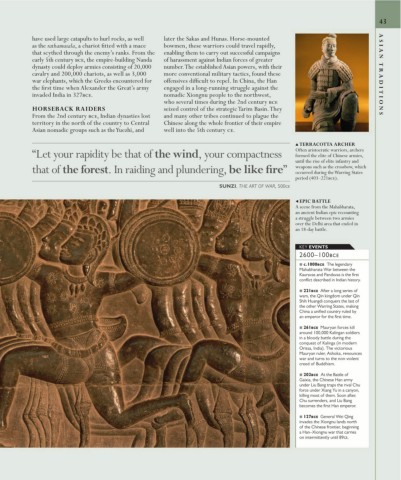
◀ EPIC BATTLE
A scene from the Mahabharata,
an ancient Indian epic recounting
a struggle between two armies
over the Delhi area that ended in
an 18-day battle.
KEY EVENTS
2600–100bce
◼ c.1000bce The legendary
Mahabharata War between the
Kauravas and Pandavas is the first
conflict described in Indian history.
◼ 221bce After a long series of
wars, the Qin kingdom under Qin
Shih Huangdi conquers the last of
the other Warring States, making
China a unified country ruled by
an emperor for the first time.
◼ 261bce Mauryan forces kill
around 100,000 Kalingan soldiers
in a bloody battle during the
conquest of Kalinga (in modern
Orissa, India). The victorious
Mauryan ruler, Ashoka, renounces
war and turns to the non-violent
creed of Buddhism.
◼ 202bce At the Battle of
Gaixia, the Chinese Han army
under Liu Bang traps the rival Chu
force under Xiang Yu in a canyon,
killing most of them. Soon after,
Chu surrenders, and Liu Bang
becomes the first Han emperor.
◼ 127bce General Wei Qing
invades the Xiongnu lands north
of the Chinese frontier, beginning
a Han–Xiongnu war that carries
on intermittently until 89ce.

