


Page 44 - (DK) Smithsinian - Military History: The Definitive Visual Guide to the Objects of Warfare
P. 44
42

         CE   KEY BATTLE                 KEY DEVELOPMENT
              THE BATTLE OF
         O 500  THE RED CLIFFS           ASIAN TRADITIONS
              208ce
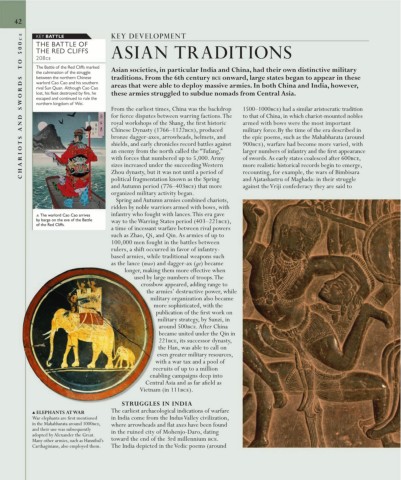
              The Battle of the Red Cliffs marked
         ORDS   T  the culmination of the struggle   Asian societies, in particular India and China, had their own distinctive military
                                         traditions. From the 6th century BCE onward, large states began to appear in these
              between the northern Chinese
              warlord Cao Cao and his southern
                                         areas that were able to deploy massive armies. In both China and India, however,
              rival Sun Quan. Although Cao Cao
                                         these armies struggled to subdue nomads from Central Asia.
              lost, his fleet destroyed by fire, he
              escaped and continued to rule the
         AND SW  northern kingdom of Wei.  From the earliest times, China was the backdrop   1500–1000bce) had a similar aristocratic tradition
                                                                                        to that of China, in which chariot-mounted nobles
                                         for fierce disputes between warring factions. The
                                         royal workshops of the Shang, the first historic
                                                                                        armed with bows were the most important
         TS                              Chinese Dynasty (1766–1122bce), produced       military force.By the time of the era described in
                                         bronze dagger-axes, arrowheads, helmets, and
                                                                                        the epic poems, such as the Mahabharata (around
                                         shields, and early chronicles record battles against
                                                                                        900bce), warfare had become more varied, with
         CHARIO                          with forces that numbered up to 5,000. Army    of swords. As early states coalesced after 600bce,
                                         an enemy from the north called the “Tufang,”
                                                                                        larger numbers of infantry and the first appearance
                                         sizes increased under the succeeding Western
                                                                                        more realistic historical records begin to emerge,
                                         Zhou dynasty, but it was not until a period of
                                                                                        recounting, for example, the wars of Bimbisara
                                         political fragmentation known as the Spring
                                                                                        against the Vriji confederacy they are said to
                                         and Autumn period (776–403bce) that more       and Ajatashastru of Maghada: in their struggle
                                         organized military activity began.
                                          Spring and Autumn armies combined chariots,
                                         ridden by noble warriors armed with bows, with
              ▲ The warlord Cao Cao arrives   infantry who fought with lances. This era gave
              by barge on the eve of the Battle    way to the Warring States period (403–221bce),
              of the Red Cliffs.
                                         a time of incessant warfare between rival powers
                                         such as Zhao, Qi, and Qin. As armies of up to
                                         100,000 men fought in the battles between
                                         rulers, a shift occurred in favor of infantry-
                                         based armies, while traditional weapons such
                                         as the lance (mao) and dagger-ax (ge) became
                                             longer, making them more effective when
                                                 used by large numbers of troops. The
                                                   crossbow appeared, adding range to
                                                     the armies’ destructive power, while
                                                       military organization also became
                                                        more sophisticated, with the
                                                         publication of the first work on
                                                         military strategy, by Sunzi, in
                                                          around 500bce. After China
                                                          became united under the Qin in
                                                          221bce, its successor dynasty,
                                                         the Han, was able to call on
                                                         even greater military resources,
                                                        with a war tax and a pool of
                                                        recruits of up to a million
                                                      enabling campaigns deep into
                                                     Central Asia and as far afield as
                                                   Vietnam (in 111bce).

                                            STRUGGLES IN INDIA
            ▲ ELEPHANTS AT WAR           The earliest archaeological indications of warfare
            War elephants are first mentioned    in India come from the Indus Valley civilization,
            in the Mahabharata around 1000bce,   where arrowheads and flat axes have been found
            and their use was subsequently   in the ruined city of Mohenjo-Daro, dating
            adopted by Alexander the Great.
            Many other armies, such as Hannibal’s   toward the end of the 3rd millennium bce.
            Carthaginians, also employed them.  The India depicted in the Vedic poems (around

