


Page 40 - (DK) Smithsinian - Military History: The Definitive Visual Guide to the Objects of Warfare
P. 40
38
                                                                                                   Cavalry barracks  North gate
         CE   ROMAN FORTIFICATION
         O 500  ARBEIA FORT


         ORDS   T  The Roman army built the ancient world’s greatest fortifications.       West gate               Workshops      East gate
            Legionaries were more like combat engineers than ordinary
            soldiers, being trained in construction as well as the art of battle.
                                                                                                                                  Commanding
                                                                                                                                  officer’s
            On campaign, a legion made a wooden
                                                     the empire. Living conditions were basic
                                                                                                                                  house
         AND SW  camp, surrounded by an earth rampart, at   and cramped—units of eight soldiers        Granaries  Headquarters
            every stop. Permanent forts were initially
                                                     called contubernia, or “tent groups,” shared
            also made of wood and earth, but later ones,  small, two-roomed suites in the barracks.
                                                     However, with heated bathhouses and
            like the reconstructed Arbeia, in northeast
         TS   England, were stone-built. Used as barracks,  latrines cleaned by running water, hygiene    South gate  Infantry barracks
                                                     standards were relatively high.
            administrative centers, and supply depots,
                                                       Arbeia was a small fort, housing about
            they maintained a military presence in
         CHARIO  potentially hostile territory.      600 auxiliary troops, both infantry and   LAYOUT OF A ROMAN FORT
                                                                                                                           PLAN VIEW
              Outposts of Roman civilization, the forts  cavalry. Built in the 2nd century ce, it
                                                                                              Large or small, most Roman forts were built to a
                                                     was a major supply center for the troops
            made no concessions to local climates or
                                                                                              similar plan, with barracks for cavalry and infantry,
                                                     on Hadrian’s Wall to the north.
            cultures, displaying similar features across
                                                                                              workshops, granaries, and a separate headquarters.
              FORT ENTRANCE


            ▲ GATEHOUSE PLAQUE
            The plaque states that the fort was built by Legio VI
            Victrix under Sextus Calpurnius Agricola, governor
            of Britain (c.163–66ce).


            ▲ DOORS AND WALLS
            Solid stone walls and thick wooden doors would
            have kept out the bands of tribal fighters who
            occasionally carried out raids in Roman Britain.


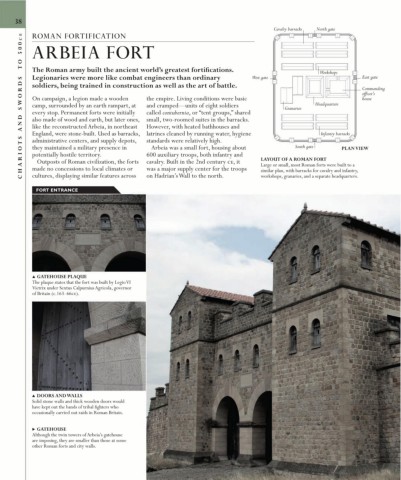
            ▶ GATEHOUSE
            Although the twin towers of Arbeia’s gatehouse
            are imposing, they are smaller than those at some
            other Roman forts and city walls.

