


Page 47 - (DK) Smithsinian - Military History: The Definitive Visual Guide to the Objects of Warfare
P. 47
45

                                                               AN ANCIENT CHINESE ARMY
                                                               TERRACOTTA                                                               TERRA


                                                               WARRIORS                                                                 CO


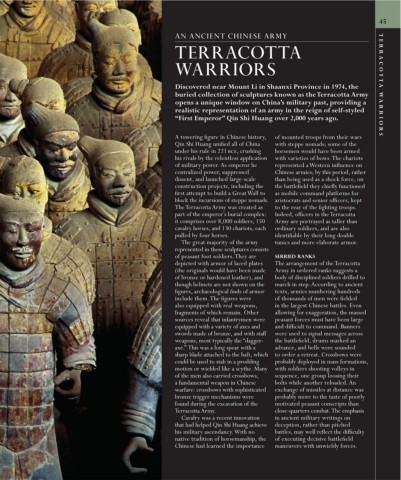
                                                               Discovered near Mount Li in Shaanxi Province in 1974, the                TT
                                                               buried collection of sculptures known as the Terracotta Army             A W
                                                               opens a unique window on China’s military past, providing a
                                                               realistic representation of an army in the reign of self-styled
                                                               “First Emperor” Qin Shi Huang over 2,000 years ago.                      ARRIORS


                                                               A towering figure in Chinese history,   of mounted troops from their wars
                                                               Qin Shi Huang unified all of China   with steppe nomads; some of the
                                                               under his rule in 221 bce, crushing   horsemen would have been armed
                                                               his rivals by the relentless application  with varieties of bows. The chariots
                                                               of military power. As emperor he    represented a Western influence on
                                                               centralized power, suppressed       Chinese armies; by this period, rather
                                                               dissent, and launched large-scale   than being used as a shock force, on
                                                               construction projects, including the   the battlefield they chiefly functioned
                                                               first attempt to build a Great Wall to   as mobile command platforms for
                                                               block the incursions of steppe nomads.  aristocrats and senior officers, kept
                                                               The Terracotta Army was created as   to the rear of the fighting troops.
                                                               part of the emperor’s burial complex:   Indeed, officers in the Terracotta
                                                               it comprises over 8,000 soldiers, 150   Army are portrayed as taller than
                                                               cavalry horses, and 130 chariots, each   ordinary soldiers, and are also
                                                               pulled by four horses.              identifiable by their long double
                                                                  The great majority of the army   tunics and more elaborate armor.
                                                               represented in these sculptures consists
                                                               of peasant foot soldiers. They are   SERRIED RANKS
                                                               depicted with armor of laced plates   The arrangement of the Terracotta
                                                               (the originals would have been made   Army in ordered ranks suggests a
                                                               of bronze or hardened leather), and   body of disciplined soldiers drilled to
                                                               though helmets are not shown on the   march in step. According to ancient
                                                               figures, archaeological finds of armor   texts, armies numbering hundreds
                                                               include them. The figures were      of thousands of men were fielded
                                                               also equipped with real weapons,    in the largest Chinese battles. Even
                                                               fragments of which remain. Other    allowing for exaggeration, the massed
                                                               sources reveal that infantrymen were   peasant forces must have been large
                                                               equipped with a variety of axes and   and difficult to command. Banners
                                                               swords made of bronze, and with staff   were used to signal messages across
                                                               weapons, most typically the “dagger-  the battlefield, drums marked an
                                                               axe.”  This was a long spear with a   advance, and bells were sounded
                                                               sharp blade attached to the haft, which  to order a retreat. Crossbows were
                                                               could be used to stab in a prodding   probably deployed in mass formations,
                                                               motion or wielded like a scythe. Many  with soldiers shooting volleys in
                                                               of the men also carried crossbows,    sequence, one group loosing their
                                                               a fundamental weapon in Chinese     bolts while another reloaded. An
                                                               warfare: crossbows with sophisticated   exchange of missiles at distance was
                                                               bronze trigger mechanisms were      probably more to the taste of poorly
                                                               found during the excavation of the   motivated peasant conscripts than
                                                               Terracotta Army.                    close-quarters combat. The emphasis
                                                                  Cavalry was a recent innovation   in ancient military writings on
                                                               that had helped Qin Shi Huang achieve  deception, rather than pitched
                                                               his military ascendancy. With no    battles, may well reflect the difficulty
                                                               native tradition of horsemanship, the   of executing decisive battlefield
                                                               Chinese had learned the importance   maneuvers with unwieldy forces.

