


Page 43 - (DK) Smithsinian - Military History: The Definitive Visual Guide to the Objects of Warfare
P. 43
41


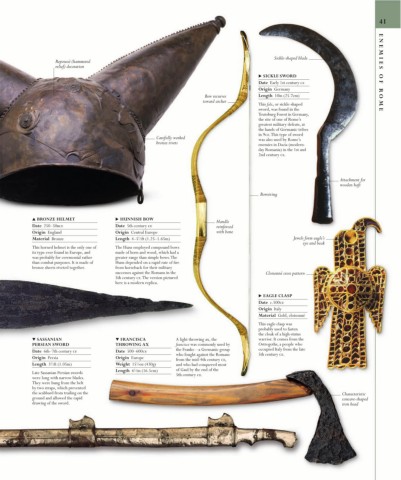
                                                                                                   Sickle-shaped blade
                     Repoussé (hammered                                                                                                 ENEMIES OF R
                     relief) decoration
                                                                                             ▶ SICKLE SWORD
                                                                                             Date  Early 1st century ce
                                                                                             Origin  Germany
                                                                          Bow recurves       Length  10in (25.7cm)
                                                                         toward archer                                                  OME
                                                                                             This falx, or sickle-shaped
                                                                                             sword, was found in the
                                                                                             Teutoburg Forest in Germany,
                                                                                             the site of one of Rome’s
                                                                                             greatest military defeats, at
                                                                                             the hands of Germanic tribes
                                                                                             in 9ce. This type of sword
                                                         Carefully worked                    was also used by Rome’s
                                                         bronze rivets                       enemies in Dacia (modern-
                                                                                             day Romania) in the 1st and
                                                                                             2nd century ce.


                                                                                                                          Attachment for
                                                                                                                          wooden haft
                                                                                              Bowstring


            ▲ BRONZE HELMET               ▶ HUNNISH BOW
                                                                              Handle
            Date  250–50bce               Date  5th century ce                reinforced
            Origin  England               Origin  Central Europe              with bone
                                                  1
            Material  Bronze              Length  4–5 ⁄2ft (1.25–1.65m)                                   Jewels form eagle’s
                                                                                                             eye and beak
            This horned helmet is the only one of   The Huns employed compound bows
            its type ever found in Europe, and   made of horn and wood, which had a
            was probably for ceremonial rather   greater range than simple bows. The
            than combat purposes. It is made of   Huns depended on a rapid rate of fire
            bronze sheets riveted together.  from horseback for their military
                                          successes against the Romans in the                   Cloisonné cross pattern
                                          5th century ce. The version pictured
                                          here is a modern replica.

                                                                                             ▶ EAGLE CLASP
                                                                                             Date  c.500ce
                                                                                             Origin  Italy
                                                                                             Material  Gold, cloisonné
                                                                                             This eagle clasp was
                                                                                             probably used to fasten
                                                                                             the cloak of a high-status
            ▼ SASSANIAN                   ▼ FRANCISCA           A light throwing ax, the     warrior. It comes from the
            PERSIAN SWORD                 THROWING AX           francisca was commonly used by   Ostrogoths, a people who
            Date  6th–7th century ce      Date  500–600ce       the Franks—a Germanic group   occupied Italy from the late
                                                                who fought against the Romans   5th century ce.
            Origin  Persia                Origin  Europe
                                                                from the mid-4th century ce,
                                                  1
                   1
            Length  3 ⁄2ft (1.05m)        Weight  15 ⁄4oz (430g)  and who had conquered most
                                          Length  6 ⁄2in (16.5cm)  of Gaul by the end of the
                                                 1
            Late Sassanian Persian swords                       5th century ce.
            were long with narrow blades.
            They were hung from the belt
            by two straps, which prevented
            the scabbard from trailing on the                                                                              Characteristic
            ground and allowed the rapid                                                                                   concave-shaped
            drawing of the sword.                                                                                          iron head

