


Page 52 - (DK) Smithsinian - Military History: The Definitive Visual Guide to the Objects of Warfare
P. 52
50      KEY BATTLE                 KEY DEVELOPMENT

         WMEN 500–1500  BATTLE OF        THE WEAPONS OF EARLY


              POITIERS (TOURS)
              732ce
                                         MEDIEVAL EUROPE
              An army of Arab and Berber
              horsemen from Spain—an
              area recently conquered by the
              Muslims—invaded Frankish territory
                                         From 500CE to 1000, the relatively weak states of western Europe were prey
              in 732ce. Charles Martel, leader
              between Tours and Poitiers.
                                         in mounted combat was becoming a significant factor on the battlefield.
         AND BO  of the Franks, confronted them   for raiders. By the 11th century, however, improved use of armored cavalry
              The Frankish warriors fought
              dismounted in a tightly-packed
              square, and held off the Muslims
                                         The fall of the Roman Empire in western
              with sword, spear, and shield to
                                         Europe, in the 5th century ce, was followed
              win a famous defensive victory.
                                         by a general decline in political organization
         KNIGHTS                         and technology. This was not true, however,
                                         of the Byzantine Empire, the successor to the
                                         Roman Empire in the east. Despite many setbacks,
                                         the Byzantine imperial system retained its resources
                                         and organization to field an impressive army,
                                         centered around heavily armored cavalry, known
                                         as cataphracts. The empire also maintained a
                                         formidable navy, and even devised an advanced
                                         secret weapon: the flammable liquid known as
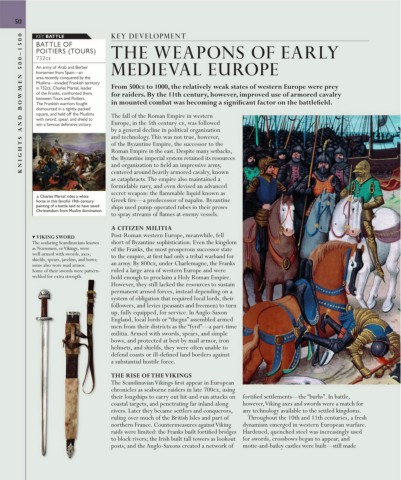
              ▲ Charles Martel rides a white
              horse in this fanciful 19th-century   Greek fire—a predecessor of napalm. Byzantine
              painting of a battle said to have saved   ships used pump-operated tubes in their prows
              Christendom from Muslim domination.
                                         to spray streams of flames at enemy vessels.

                                         A CITIZEN MILITIA
            ▼ VIKING SWORD               Post-Roman western Europe, meanwhile, fell
            The seafaring Scandinavians known    short of Byzantine sophistication. Even the kingdom
            as Norsemen, or Vikings, were   of the Franks, the most prosperous successor state
            well-armed with swords, axes,   to the empire, at first had only a tribal warband for
            shields, spears, javelins, and bows;
            some also wore mail armor.    an army. By 800ce, under Charlemagne, the Franks
            Some of their swords were pattern-  ruled a large area of western Europe and were
            welded for extra strength.   bold enough to proclaim a Holy Roman Empire.
                                         However, they still lacked the resources to sustain
                                         permanent armed forces, instead depending on a
                                         system of obligation that required local lords, their
                                         followers, and levies (peasants and freemen) to turn
                                         up, fully equipped, for service. In Anglo-Saxon
                                         England, local lords or “thegns” assembled armed
                                         men from their districts as the “fyrd”—a part-time
                                         militia. Armed with swords, spears, and simple
                                         bows, and protected at best by mail armor, iron
                                         helmets, and shields, they were often unable to
                                         defend coasts or ill-defined land borders against
                                         a substantial hostile force.

                                         THE RISE OF THE VIKINGS
                                         The Scandinavian Vikings first appear in European
                                         chronicles as seaborne raiders in late 700ce, using
                                         their longships to carry out hit-and-run attacks on  fortified settlements—the “burhs”. In battle,
                                         coastal targets, and penetrating far inland along   however, Viking axes and swords were a match for
                                         rivers. Later they became settlers and conquerors,   any technology available to the settled kingdoms.
                                         ruling over much of the British Isles and part of   Throughout the 10th and 11th centuries, a fresh
                                         northern France. Countermeasures against Viking   dynamism emerged in western European warfare.
                                         raids were limited: the Franks built fortified bridges  Hardened, quenched steel was increasingly used
                                         to block rivers; the Irish built tall towers as lookout  for swords, crossbows began to appear, and
                                         posts; and the Anglo-Saxons created a network of   motte-and-bailey castles were built—still made

