


Page 53 - (DK) Smithsinian - Military History: The Definitive Visual Guide to the Objects of Warfare
P. 53
51


            “Shields, helmets and coats of mail

            were shivered by the furious and

            impatient thrusts of his sword;

            some he dashed to earth with his shield”                                                                                    THE  WEAPONS OF EARL


              ORDERIC VITALIS, ON WILLIAM THE CONQUEROR AT HASTINGS, c.1130ce


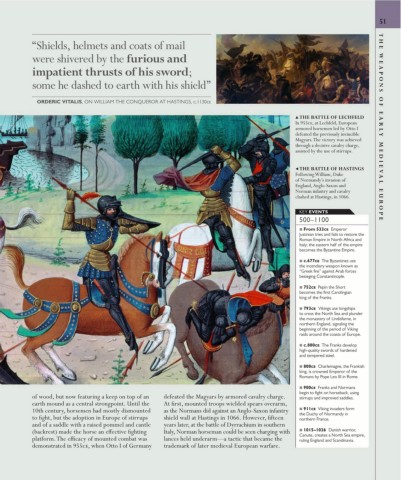
                                                                                                          ▲ THE BATTLE OF LECHFELD
                                                                                                          In 955ce, at Lechfeld, European
                                                                                                          armored horsemen led by Otto I
                                                                                                          defeated the previously invincible
                                                                                                          Magyars. The victory was achieved
                                                                                                          through a decisive cavalry charge,
                                                                                                          assisted by the use of stirrups.


                                                                                                          ◀ THE BATTLE OF HASTINGS      Y MEDIEV AL EUR
                                                                                                          Following William, Duke
                                                                                                          of Normandy’s invasion of
                                                                                                          England, Anglo-Saxon and
                                                                                                          Norman infantry and cavalry
                                                                                                          clashed at Hastings, in 1066.


                                                                                                            KEY EVENTS                  OPE
                                                                                                            500–1100
                                                                                                            ◼ From 533ce  Emperor
                                                                                                            Justinian tries and fails to restore the
                                                                                                            Roman Empire in North Africa and
                                                                                                            Italy; the eastern half of the empire
                                                                                                            becomes the Byzantine Empire.

                                                                                                            ◼ c.677ce  The Byzantines use
                                                                                                            the incendiary weapon known as
                                                                                                            “Greek fire” against Arab forces
                                                                                                            besieging Constantinople.
                                                                                                            ◼ 752ce  Pepin the Short
                                                                                                            becomes the first Carolingian
                                                                                                            king of the Franks.
                                                                                                            ◼ 793ce  Vikings use longships
                                                                                                            to cross the North Sea and plunder
                                                                                                            the monastery of Lindisfarne, in
                                                                                                            northern England, signaling the
                                                                                                            beginning of the period of Viking
                                                                                                            raids around the coasts of Europe.
                                                                                                            ◼ c.800ce  The Franks develop
                                                                                                            high-quality swords of hardened
                                                                                                            and tempered steel.
                                                                                                            ◼ 800ce  Charlemagne, the Frankish
                                                                                                            king, is crowned Emperor of the
                                                                                                            Romans by Pope Leo III in Rome.

                                                                                                            ◼ 900ce  Franks and Normans
                                                                                                            begin to fight on horseback, using
            of wood, but now featuring a keep on top of an   defeated the Magyars by armored cavalry charge.   stirrups and improved saddles.
            earth mound as a central strongpoint. Until the    At first, mounted troops wielded spears overarm,
            10th century, horsemen had mostly dismounted    as the Normans did against an Anglo-Saxon infantry   ◼ 911ce  Viking invaders form
            to fight, but the adoption in Europe of stirrups    shield wall at Hastings in 1066. However, fifteen   the Duchy of Normandy in
                                                                                                            northern France.
            and of a saddle with a raised pommel and cantle   years later, at the battle of Dyrrachium in southern
            (backrest) made the horse an effective fighting   Italy, Norman horseman could be seen charging with   ◼ 1015–1026  Danish warrior,
            platform. The efficacy of mounted combat was   lances held underarm—a tactic that became the    Canute, creates a North Sea empire,
                                                                                                            ruling England and Scandinavia.
            demonstrated in 955ce, when Otto I of Germany   trademark of later medieval European warfare.

