


Page 55 - (DK) Smithsinian - Military History: The Definitive Visual Guide to the Objects of Warfare
P. 55
53

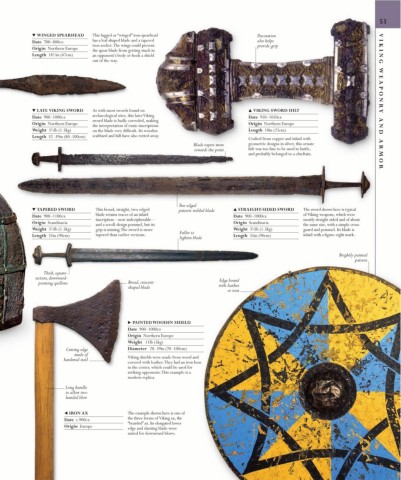
            ▼ WINGED SPEARHEAD    This lugged or “winged” iron spearhead                     Decoration
            Date  700–800ce       has a leaf-shaped blade and a tapered                      also helps
                                  iron socket. The wings could prevent                       provide grip
            Origin  Northern Europe  the spear blade from getting stuck in
                    1
            Length  18 ⁄2in (47cm)  an opponent’s body or hook a shield
                                  out of the way.                                                                                       VIKING  WEAPONR


            ▼ LATE  VIKING SWORD  As with most swords found on                            ▲ VIKING SWORD HILT
            Date  900–1000ce      archaeological sites, this later Viking                 Date  950–1050ce
                                  sword blade is badly corroded, making
            Origin  Northern Europe  the interpretation of runic inscriptions             Origin  Northern Europe
                   1
            Weight  3 ⁄4lb (1.5kg)  on the blade very difficult. Its wooden               Length  10in (25cm)
            Length  32–39in (80–100cm)  scabbard and hilt have also rotted away.          Crafted from copper and inlaid with           Y AND ARMOR
                                                                      Blade tapers more   geometric designs in silver, this ornate
                                                                      towards the point   hilt was too fine to be used in battle,
                                                                                          and probably belonged to a chieftain.


                                                                 Two-edged
            ▼ TAPERED SWORD        This broad, straight, two-edged    pattern-welded blade  ▲ STRAIGHT-SIDED SWORD  The sword shown here is typical
            Date  900–1100ce       blade retains traces of an inlaid                Date  900–1000ce         of  Viking weapons, which were
                                   inscription—now indecipherable—                                           mostly straight-sided and of about
            Origin  Scandinavia    and a scroll-design pommel, but its              Origin  Scandinavia      the same size, with a simple cross-
            Weight  3 ⁄4lb (1.5kg)  grip is missing. The sword is more              Weight  3 ⁄4lb (1.5kg)   guard and pommel. Its blade is
                                                                                           1
                   1
            Length  35in (90cm)    tapered than earlier versions.  Fuller to        Length  35in (90cm)      inlaid with a figure-eight mark.
                                                                 lighten blade
                                                                                                                          Brightly painted
                                                                                                                                pattern

                Thick, square-
             section, downward-                                                Edge bound
               pointing quillons               Broad, crescent-
                                               shaped blade                    with leather
                                                                                  or iron


                                              ▶ PAINTED WOODEN SHIELD
                                              Date  900–1000ce
                                              Origin  Northern Europe
                                              Weight   11lb (5kg)
                        Cutting edge          Diameter   28–39in (70–100cm)
                           made of
                        hardened steel        Viking shields were made from wood and
                                              covered with leather. They had an iron boss
                                              in the center, which could be used for
                                              striking opponents. This example is a
                                              modern replica.
                        Long handle
                        to allow two-
                        handed blow

                        ◀ IRON AX             The example shown here is one of
                        Date  c.900ce         the three forms of  Viking ax, the
                                              “bearded” ax. Its elongated lower
                        Origin  Europe        edge and slanting blade were
                                              suited for downward blows.

