


Page 56 - (DK) Smithsinian - Military History: The Definitive Visual Guide to the Objects of Warfare
P. 56
54    VIKING LONGSHIP                                                                            Yard         Mast

         WMEN 500–1500  HAVHINGSTEN FRA                                                     Back stay Sail                      Fore stay


            GLENDALOUGH
                                                                                                                                  Prow

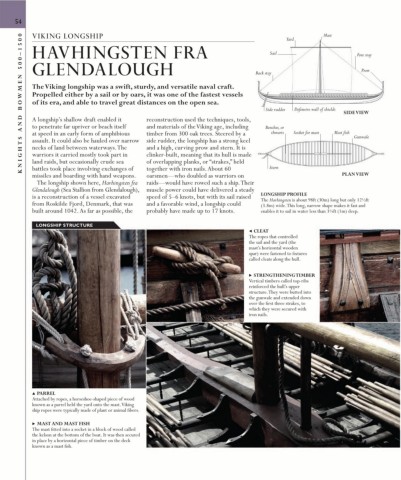
            The Viking longship was a swift, sturdy, and versatile naval craft.


            of its era, and able to travel great distances on the open sea.
         AND BO  Propelled either by a sail or by oars, it was one of the fastest vessels       Side rudder  Socket for mast  Mast fish
                                                                                                          Defensive wall of shields
                                                                                                                            SIDE VIEW
            A longship’s shallow draft enabled it
                                                     reconstruction used the techniques, tools,
                                                     and materials of the Viking age, including
            to penetrate far upriver or beach itself
                                                                                                Benches, or
            at speed in an early form of amphibious
                                                     timber from 300 oak trees. Steered by a
                                                                                                  thwarts
         KNIGHTS   assault. It could also be hauled over narrow  side rudder, the longship has a strong keel                   Gunwale
            necks of land between waterways. The
                                                     and a high, curving prow and stern. It is
                                                     clinker-built, meaning that its hull is made
            warriors it carried mostly took part in
            land raids, but occasionally crude sea
                                                     of overlapping planks, or “strakes,” held
            battles took place involving exchanges of
                                                     oarsmen—who doubled as warriors on
            missiles and boarding with hand weapons.   together with iron nails. About 60        Stern                     PLAN VIEW
              The longship shown here, Havhingsten fra   raids—would have rowed such a ship. Their
            Glendalough (Sea Stallion from Glendalough),  muscle power could have delivered a steady
            is a reconstruction of a vessel excavated   speed of 5–6 knots, but with its sail raised   LONGSHIP PROFILE
            from Roskilde Fjord, Denmark, that was   and a favorable wind, a longship could   The Havhingsten is about 98ft (30m) long but only 12½ft
                                                                                              (3.8m) wide. This long, narrow shape makes it fast and
            built around 1042. As far as possible, the   probably have made up to 17 knots.   enables it to sail in water less than 3¼ft (1m) deep.
              LONGSHIP STRUCTURE
                                                                                          ◀ CLEAT
                                                                                          The ropes that controlled
                                                                                          the sail and the yard (the
                                                                                          mast’s horizontal wooden
                                                                                          spar) were fastened to fixtures
                                                                                          called cleats along the hull.


                                                                                          ▶ STRENGTHENING TIMBER
                                                                                          Vertical timbers called top-ribs
                                                                                          reinforced the hull’s upper
                                                                                          structure. They were butted into
                                                                                          the gunwale and extended down
                                                                                          over the first three strakes, to
                                                                                          which they were secured with
                                                                                          iron nails.


            ▲ PARREL
            Attached by ropes, a horseshoe-shaped piece of wood
            known as a parrel held the yard onto the mast. Viking
            ship ropes were typically made of plant or animal fibers.

            ▶ MAST AND MAST FISH
            The mast fitted into a socket in a block of wood called
            the kelson at the bottom of the boat. It was then secured
            in place by a horizontal piece of timber on the deck
            known as a mast fish.

