


Page 58 - (DK) Smithsinian - Military History: The Definitive Visual Guide to the Objects of Warfare
P. 58
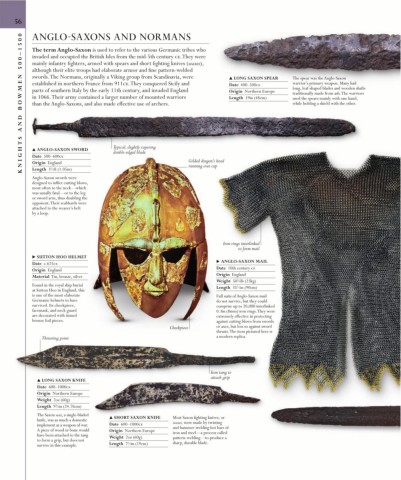
56    ANGLO-SAXONS AND NORMANS

         WMEN 500–1500  The term Anglo-Saxon is used to refer to the various Germanic tribes who   ▲ LONG SAXON SPEAR  The spear was the Anglo-Saxon


            invaded and occupied the British Isles from the mid-5th century ce. They were
            mainly infantry fighters, armed with spears and short fighting knives (seaxes),
            although their elite troops had elaborate armor and fine pattern-welded
            swords. The Normans, originally a  Viking group from Scandinavia, were
            established in northern France from 911ce. They conquered Sicily and
                                                                                                         warrior’s primary weapon. Many had
                                                                                   Date  400–500ce
                                                                                                         long, leaf-shaped blades and wooden shafts
            parts of southern Italy by the early 11th century, and invaded England
                                                                                   Origin  Northern Europe
                                                                                                         used the spears mainly with one hand,
         AND BO  in 1066. Their army contained a larger number of mounted warriors    Length  19in (48cm)  traditionally made from ash. The warriors
                                                                                                         while holding a shield with the other.
            than the Anglo-Saxons, and also made effective use of archers.

         KNIGHTS   ▲ ANGLO-SAXON SWORD   Typical, slightly tapering   Gilded dragon’s head

                                         double-edged blade
            Date  500–600ce
            Origin  England
                   1
            Length  3 ⁄2ft (1.05m)
            Anglo-Saxon swords were                                 running over cap
            designed to inflict cutting blows,
            most often to the neck—which
            was usually fatal—or to the leg
            or sword arm, thus disabling the
            opponent. Their scabbards were
            attached to the wearer’s belt
            by a loop.


                                                                                Iron rings interlinked
                                                                                      to form mail
            ▶ SUTTON HOO HELMET
                                                                              ▶ ANGLO-SAXON MAIL
            Date  c.625ce
            Origin  England                                                   Date  10th century ce
                                                                              Origin  England
            Material  Tin, bronze, silver
                                                                                      3
                                                                              Weight  50 ⁄4lb (23kg)
            Found in the royal ship burial                                    Length  35 ⁄2in (90cm)
                                                                                     1
            at Sutton Hoo in England, this
            is one of the most elaborate                                      Full suits of Anglo-Saxon mail
            Germanic helmets to have                                          do not survive, but they could
            survived. Its cheekpiece,                                         comprise up to 20,000 interlinked
            facemask, and neck guard                                          0.3in (8mm) iron rings. They were
            are decorated with tinned                                         extremely effective in protecting
            bronze foil pieces.                                               against cutting blows from swords
                                                             Cheekpiece       or axes, but less so against sword
                                                                              thrusts. The item pictured here is
                                                                              a modern replica.
                Thrusting point


                                                                            Iron tang to
                                                                            attach grip
              ▲ LONG SAXON KNIFE
              Date  600–1000ce
              Origin  Northern Europe
              Weight  2oz (60g)
              Length  9 ⁄4in (24.76cm)
                     3
              The Saxon seax, a single-bladed
              knife, was as much a domestic   ▲ SHORT SAXON KNIFE  Most Saxon fighting knives, or
              implement as a weapon of war.   Date  600–1000ce  seaxes, were made by twisting
              A piece of wood or bone would   Origin  Northern Europe  and hammer-welding hot bars of
              have been attached to the tang   Weight  2oz (60g)  iron and steel—a process called
              to form a grip, but does not                     pattern-welding—to produce a
                                              1
              survive in this example.  Length  7 ⁄2in (19cm)  sharp, durable blade.

