


Page 68 - (DK) Smithsinian - Military History: The Definitive Visual Guide to the Objects of Warfare
P. 68
66    KNIGHTS’ HELMETS                                                                            Ovoid,

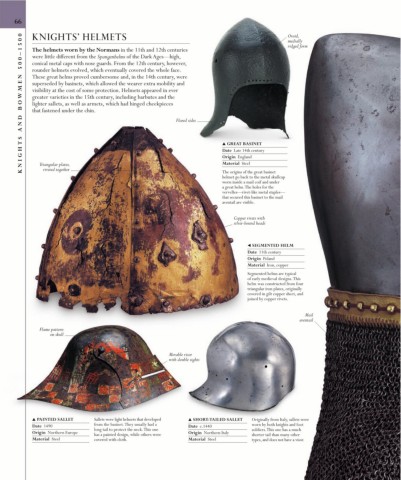
         WMEN 500–1500  The helmets worn by the Normans in the 11th and 12th centuries                  ridged form
                                                                                                        medially

            were little different from the Spangenhelms of the Dark Ages—high,
            conical metal caps with nose guards. From the 12th century, however,
            rounder helmets evolved, which eventually covered the whole face.
            These great helms proved cumbersome and, in the 14th century, were
            superseded by basinets, which allowed the wearer extra mobility and
            visibility at the cost of some protection. Helmets appeared in ever

         AND BO  greater varieties in the 15th century, including barbutes and the   Flared sides
            lighter sallets, as well as armets, which had hinged cheekpieces
            that fastened under the chin.


         KNIGHTS   Triangular plates,                                           ▲ GREAT BASINET

                                                                                Date  Late 14th century
                                                                                Origin  England
                                                                                Material  Steel
                riveted together
                                                                                The origins of the great basinet
                                                                                helmet go back to the metal skullcap
                                                                                worn inside a mail coif and under
                                                                                a great helm. The holes for the
                                                                                vervelles—rivet-like metal staples—
                                                                                that secured this basinet to the mail
                                                                                aventail are visible.


                                                                                    Copper rivets with
                                                                                    silver-bound heads


                                                                                         ◀ SEGMENTED HELM
                                                                                         Date  11th century
                                                                                         Origin  Poland
                                                                                         Material  Iron, copper
                                                                                         Segmented helms are typical
                                                                                         of early medieval designs. This
                                                                                         helm was constructed from four
                                                                                         triangular iron plates, originally
                                                                                         covered in gilt copper sheet, and
                                                                                         joined by copper rivets.


                                                                                                              Mail
                                                                                                            aventail
               Flame pattern
                   on skull


                                                             Movable visor
                                                             with double sights


            ▲ PAINTED SALLET      Sallets were light helmets that developed   ▲ SHORT-TAILED SALLET  Originally from Italy, sallets were
            Date  1490            from the basinet. They usually had a   Date  c.1440      worn by both knights and foot
                                  long tail to protect the neck. This one                  soldiers. This one has a much
            Origin  Northern Europe  has a painted design, while others were   Origin  Northern Italy  shorter tail than many other
            Material  Steel       covered with cloth.               Material  Steel        types, and does not have a visor.

