Page 65 - (DK) Smithsinian - Military History: The Definitive Visual Guide to the Objects of Warfare
P. 65
63


                                                                          Spike protruded from spur,
                                                                       worn on the heel by the knight                                   KNIGHTS’


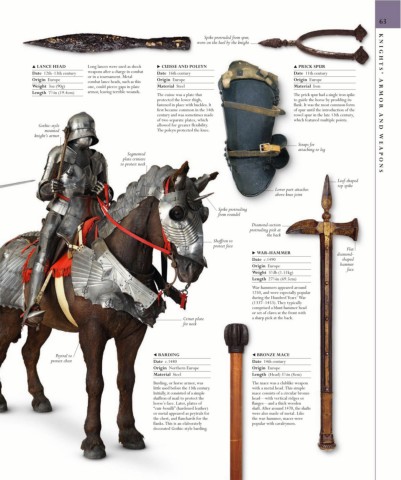
            ▲ LANCE HEAD        Long lances were used as shock   ▶ CUISSE AND POLEYN                      ▲ PRICK SPUR
            Date  12th–13th century  weapons after a charge in combat   Date  16th century                Date  11th century
                                or in a tournament. Metal
            Origin  Europe                               Origin  Europe                                   Origin  Europe
                                combat lance heads, such as this
            Weight  3oz (90g)   one, could pierce gaps in plate   Material  Steel                         Material  Iron
                   1
            Length  7 ⁄2in (19.4cm)  armor, leaving terrible wounds.
                                                         The cuisse was a plate that                      The prick spur had a single iron spike
                                                         protected the lower thigh,                       to guide the horse by prodding its
                                                         fastened in place with buckles. It               flank. It was the most common form
                                                         first became common in the 14th                  of spur until the introduction of the
                                                         century and was sometimes made                   rowel spur in the late 13th century,
                                                         of two separate plates, which                    which featured multiple points.
               Gothic-style                              allowed for greater flexibility.                                                ARMOR AND  WEAPONS
                 mounted                                 The poleyn protected the knee.
             knight’s armor
                                                                                                           Straps for
                                                                                                           attaching to leg
                                              Segmented
                                             plate criniere
                                            to protect neck


                                                                                                                         Leaf-shaped
                                                                                                                         top spike
                                                                                                   Lower part attaches
                                                                                                   above knee joint

                                                                               Spike protruding
                                                                               from roundel

                                                                                           Diamond-section
                                                                                          protruding pick at
                                                                                                the back
                                                                             Shaffron to
                                                                             protect face
                                                                                                                             Flat
                                                                                           ▶ WAR-HAMMER                  diamond-
                                                                                           Date  c.1490                    shaped
                                                                                           Origin  Europe                 hammer
                                                                                                                             face
                                                                                           Weight  3 ⁄4lb (1.51kg)
                                                                                                 1
                                                                                                  1
                                                                                           Length  27 ⁄4in (69.5cm)
                                                                                           War-hammers appeared around
                                                                                           1250, and were especially popular
                                                                                           during the Hundred  Years’  War
                                                                                           (1337–1453). They typically
                                                                                           comprised a blunt hammer head
                                                                                           or set of claws at the front with
                                                                  Crinet plate             a sharp pick at the back.
                                                                  for neck


                     Peytral to                         ◀ BARDING                          ◀ BRONZE MACE
                   protect chest                        Date  c.1480                       Date  14th century
                                                        Origin  Northern Europe            Origin  Europe
                                                                                                      1
                                                        Material  Steel                    Length  (Head) 3 ⁄4in (8cm)
                                                        Barding, or horse armor, was       The mace was a clublike weapon
                                                        little used before the 13th century.   with a metal head. This simple
                                                        Initially, it consisted of a simple   mace consists of a circular bronze
                                                        shaffron of mail to protect the    head—with vertical ridges or
                                                        horse’s face. Later, plates of     flanges—and a thick wooden
                                                        “cuir-bouilli” (hardened leather)   shaft. After around 1470, the shafts
                                                        or metal appeared as peytrals for   were also made of metal. Like
                                                        the chest, and flanchards for the   the war-hammer, maces were
                                                        flanks. This is an elaborately     popular with cavalrymen.
                                                        decorated Gothic-style barding.
   60   61   62   63   64   65   66   67   68   69   70