


Page 70 - (DK) Smithsinian - Military History: The Definitive Visual Guide to the Objects of Warfare
P. 70
68    A CLASH OF KNIGHTS

         WMEN 500–1500  THE BATTLE


            OF BOUVINES


            Although medieval rulers often launched military campaigns,


            armies at Bouvines in 1214 was a rare clash between large
         AND BO  they were wary of pitched battles. The meeting of European
            bodies of knights, a set-piece battle that epitomized the
            fighting style of the era’s armored horsemen.


         KNIGHTS   In the summer of 1214, King Philip II  stood on the defensive. Bodies of
                                                knights lowered their lances and
            of France faced an army led by the
                                                charged the facing cavalry, their lances
            Holy Roman Emperor Otto IV and
            Ferdinand, Count of Flanders. The
                                                shattering on impact, while some
            two armies encountered one another
                                                nobles sought out particular enemies
                                                against whom they held a grudge.
            near Bouvines in Flanders on July 27,
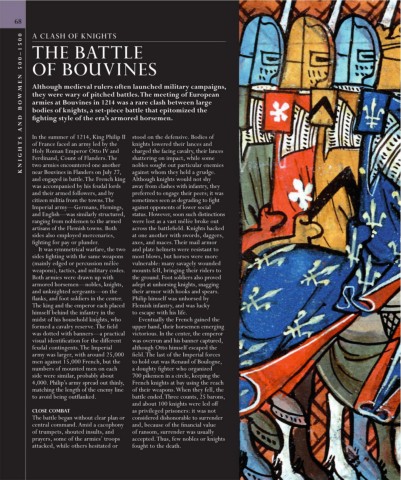
            and engaged in battle. The French king  Although knights would not shy
            was accompanied by his feudal lords   away from clashes with infantry, they
            and their armed followers, and by   preferred to engage their peers; it was
            citizen militia from the towns. The   sometimes seen as degrading to fight
            Imperial army—Germans, Flemings,    against opponents of lower social
            and English—was similarly structured,  status. However, soon such distinctions
            ranging from noblemen to the armed   were lost as a vast mêlée broke out
            artisans of the Flemish towns. Both   across the battlefield. Knights hacked
            sides also employed mercenaries,    at one another with swords, daggers,
            fighting for pay or plunder.        axes, and maces. Their mail armor
               It was symmetrical warfare, the two  and plate helmets were resistant to
            sides fighting with the same weapons   most blows, but horses were more
            (mainly edged or percussion mêlée   vulnerable: many savagely wounded
            weapons), tactics, and military codes.  mounts fell, bringing their riders to
            Both armies were drawn up with      the ground. Foot soldiers also proved
            armored horsemen—nobles, knights,   adept at unhorsing knights, snagging
            and unknighted sergeants—on the     their armor with hooks and spears.
            flanks, and foot soldiers in the center.   Philip himself was unhorsed by
            The king and the emperor each placed  Flemish infantry, and was lucky
            himself behind the infantry in the   to escape with his life.
            midst of his household knights, who   Eventually the French gained the
            formed a cavalry reserve. The field    upper hand, their horsemen emerging
            was dotted with banners—a practical  victorious. In the center, the emperor
            visual identification for the different   was overrun and his banner captured,
            feudal contingents. The Imperial    although Otto himself escaped the
            army was larger, with around 25,000   field. The last of the Imperial forces
            men against 15,000 French, but the   to hold out was Renaud of Boulogne,
            numbers of mounted men on each      a doughty fighter who organized
            side were similar, probably about   700 pikemen in a circle, keeping the
            4,000. Philip’s army spread out thinly,  French knights at bay using the reach
            matching the length of the enemy line   of their weapons. When they fell, the
            to avoid being outflanked.          battle ended. Three counts, 25 barons,
                                                and about 100 knights were led off
            CLOSE COMBAT                        as privileged prisoners: it was not
            The battle began without clear plan or  considered dishonorable to surrender
            central command. Amid a cacophony   and, because of the financial value
            of trumpets, shouted insults, and   of ransom, surrender was usually
            prayers, some of the armies’ troops   accepted. Thus, few nobles or knights
            attacked, while others hesitated or   fought to the death.

