


Page 69 - (DK) Smithsinian - Military History: The Definitive Visual Guide to the Objects of Warfare
P. 69
67

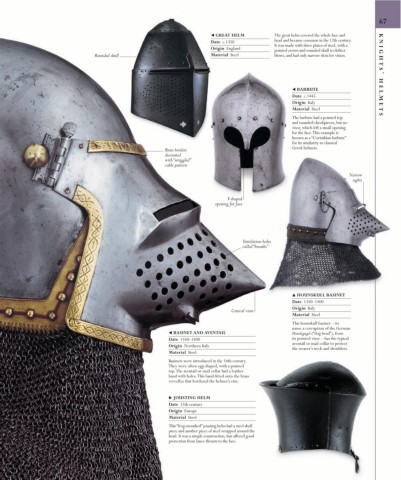
                                                                            ◀ GREAT HELM           The great helm covered the whole face and
                                                                            Date  c.1350           head and became common in the 12th century.
                                                                                                   It was made with three plates of steel, with a
                                                                            Origin  England        pointed crown and rounded skull to deflect
                                   Rounded skull                            Material  Steel        blows, and had only narrow slots for vision.  KNIGHTS


                                                                                                         ◀ BARBUTE                      ’
                                                                                                         Date  c.1445                    HELMETS
                                                                                                         Origin  Italy
                                                                                                         Material  Steel
                                                                                                         The barbute had a pointed top
                                                                                                         and rounded cheekpieces, but no
                                                                                                         visor, which left a small opening
                                                                                                         for the face. This example is
                                                                                                         known as a “Corinthian barbute”
                                                                                                         for its similarity to classical
                                                                                                         Greek helmets.
                                                            Brass borders
                                                            decorated
                                                            with “wriggled”
                                                            cable pattern
                                                                                                                             Narrow
                                                                                                                               sights


                                                                                  Y-shaped
                                                                              opening for face


                                                                                       Ventilation holes
                                                                                       called “breaths”


                                                                                                         ▲ HOUNSKULL BASINET
                                                                                                         Date  1350–1400
                                                                                                         Origin  Italy
                                                                                   Conical visor
                                                                                                         Material  Steel
                                                                                                         This hounskull basinet—its
                                                                                                         name a corruption of the German
                                                             ◀ BASINET AND AVENTAIL                      Hundsgugel (“dog head”), from
                                                             Date  1350–1400                             its pointed visor—has the typical
                                                                                                         aventail or mail collar to protect
                                                             Origin  Northern Italy
                                                                                                         the wearer’s neck and shoulders.
                                                             Material  Steel
                                                             Basinets were introduced in the 14th century.
                                                             They were often egg-shaped, with a pointed
                                                             top. The aventail or mail collar had a leather
                                                             band with holes. This band fitted onto the brass
                                                             vervelles that bordered the helmet’s rim.


                                                             ▶ JOUSTING HELM
                                                             Date  15th century
                                                             Origin  Europe
                                                             Material  Steel
                                                             This “frog-mouthed” jousting helm had a steel skull
                                                             piece and another piece of steel wrapped around the
                                                             head. It was a simple construction, but offered good
                                                             protection from lance-thrusts to the face.

