


Page 64 - (DK) Smithsinian - Military History: The Definitive Visual Guide to the Objects of Warfare
P. 64
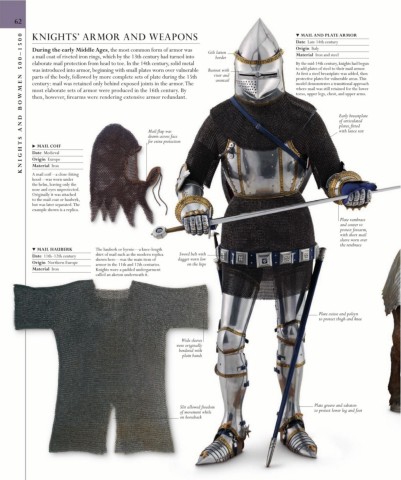
62    KNIGHTS’ ARMOR AND WEAPONS                                                                     ▼ MAIL AND PLATE ARMOR

         WMEN 500–1500  During the early Middle Ages, the most common form of armor was   Gilt latten      Origin  Italy
                                                                                                           Date  Late 14th century

                                                                                                           Material  Iron and steel
            a mail coat of riveted iron rings, which by the 13th century had turned into
                                                                              border
            elaborate mail protection from head to toe. In the 14th century, solid metal
                                                                                                           By the mid-14th century, knights had begun
                                                                                                           to add plates of steel to their mail armor.
            was introduced into armor, beginning with small plates worn over vulnerable
                                                                           Basinet with
                                                                                                           At first a steel breastplate was added, then
                                                                             visor and
            parts of the body, followed by more complete sets of plate during the 15th
                                                                                                           protective plates for vulnerable areas. This
                                                                              aventail
            century: mail was retained only behind exposed joints in the armor. The
                                                                                                           model demonstrates a transitional approach
                                                                                                           where mail was still retained for the lower
            most elaborate sets of armor were produced in the 16th century. By
         AND BO  then, however, firearms were rendering extensive armor redundant.                         torso, upper legs, chest, and upper arms.
                                                                                                                          Early breastplate
                                                                                                                          of articulated
                                                                                                                          plates, fitted
                                                                                                                          with lance rest
                                                      Mail flap was
         KNIGHTS   ▶ MAIL COIF                        drawn across face
                                                      for extra protection
            Date  Medieval
            Origin  Europe
            Material  Iron
            A mail coif—a close-fitting
            hood—was worn under
            the helm, leaving only the
            nose and eyes unprotected.
            Originally it was attached
            to the mail coat or hauberk,
            but was later separated. The
            example shown is a replica.
                                                                                                                          Plate vambrace
                                                                                                                          and couter to
                                                                                                                          protect forearm,
                                                                                                                          with short mail
                                                                                                                          sleeve worn over
                                                                                                                          the rerebrace
            ▼ MAIL HAUBERK         The hauberk or byrnie—a knee-length
            Date  11th–12th century  shirt of mail such as the modern replica   Sword belt with
                                   shown here—was the main item of   dagger worn low
            Origin  Northern Europe  armor in the 11th and 12th centuries.   on the hips
            Material  Iron         Knights wore a padded undergarment
                                   called an aketon underneath it.


                                                                                                                   Plate cuisse and poleyn
                                                                                                                   to protect thigh and knee


                                                                  Wide sleeves
                                                                were originally
                                                                 bordered with
                                                                  plain bands


                                                                                                                 Plate greave and sabaton
                                                                 Slit allowed freedom
                                                                                                                 to protect lower leg and foot
                                                                 of movement while
                                                                 on horseback

