


Page 76 - (DK) Smithsinian - Military History: The Definitive Visual Guide to the Objects of Warfare
P. 76
74    INFANTRY ARMOR

         WMEN 500–1500  AND WEAPONS


            At the start of the Middle Ages, foot soldiers, armed with spears
            and axes, played an important role on the battlefield. They were gradually
            marginalized as mounted knights became the dominant military force,
            but enjoyed a resurgence after the 13th century with the development
            of staff weapons such as pollaxes and bills (billhooks), which gave them


            in 1302, a Flemish army of townspeople and peasants, armed with godendags
         AND BO  a longer reach and enabled them to keep horsemen at bay. At Courtrai
            (long-hafted staff weapons with a spike), defeated a French army of
            feudal cavalry, marking the beginning of a new golden age of infantry.


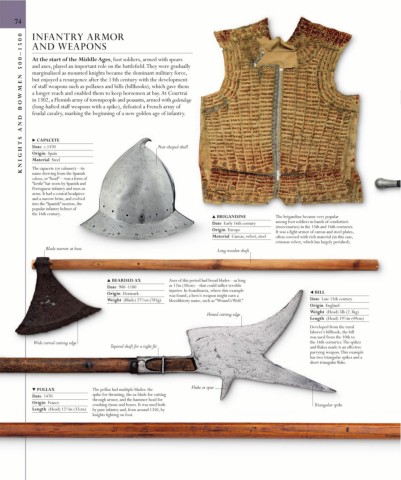
         KNIGHTS   ▶ CAPACETE                            Pear-shaped skull
            Date  c.1470
            Origin  Spain
            Material  Steel
            The capacete (or cabasset)—its
            name deriving from the Spanish
            cabeza, or “head”—was a form of
            “kettle” hat worn by Spanish and
            Portuguese infantry and men-at-
            arms. It had a conical headpiece
            and a narrow brim, and evolved
            into the “Spanish” morion, the
            popular infantry helmet of
            the 16th century.
                                                                             ▲ BRIGANDINE          The brigandine became very popular
                                                                             Date  Early 16th century  among foot soldiers in bands of condottieri
                                                                                                   (mercenaries) in the 15th and 16th centuries.
                                                                             Origin  Europe        It was a light armor of canvas and steel plates,
                                                                             Material  Canvas, velvet, steel  often covered with rich material (in this case,
                                                                                                   crimson velvet, which has largely perished).
                 Blade narrow at base
                                                                              Long wooden shaft


                                       ▲ BEARDED AX          Axes of this period had broad blades—as long
                                       Date  900–1100        as 12in (30cm)—that could inflict terrible
                                                             injuries. In Scandinavia, where this example
                                       Origin  Denmark                                                          ◀ BILL
                                                             was found, a hero’s weapon might earn a
                                                   1
                                       Weight  (Blade) 27 ⁄2oz (785g)   bloodthirsty name, such as “Wound’s Wolf.”  Date  Late 15th century
                                                                                                                Origin  England
                                                                                                                Weight  (Head) 5lb (2.3kg)
                                                                           Honed cutting edge
                                                                                                                            1
                                                                                                                Length  (Head) 19 ⁄4in (49cm)
                                                                                                                Developed from the rural
                                                                                                                laborer’s billhook, the bill
                                                                                                                was used from the 10th to
             Wide curved cutting edge                                                                           the 16th centuries. The spikes
                                        Tapered shaft for a tight fit                                           and flukes made it an effective
                                                                                                                parrying weapon. This example
                                                                                                                has two triangular spikes and a
                                                                                                                short triangular fluke.


                                                                     Fluke or spur
            ▼ POLLAX              The pollax had multiple blades: the
            Date  1470            spike for thrusting, the ax blade for cutting
                                  through armor, and the hammer head for
            Origin  France
                                  crushing tissue and bones. It was used both                                    Triangular spike
            Length  (Head) 12 ⁄2in (32cm)   by pure infantry and, from around 1350, by
                        1
                                  knights fighting on foot.

