


Page 74 - (DK) Smithsinian - Military History: The Definitive Visual Guide to the Objects of Warfare
P. 74
72      KEY EVENTS                 KEY DEVELOPMENT

         WMEN 500–1500  11th–15th century  MEDIEVAL INFANTRY


              ◼ 11th century  The crossbow
              is used in European warfare,
              notably by the Genoese.
                                         In the medieval European concept of war, foot soldiers were seen as a
                                         low-status, supporting body to mounted knights. In practice, however,
              ◼ 1139  Pope Innocent II bans the
              crossbow (along with other bows)
                                         when they employed tactics that made the best use of their weaponry,
              because of the number of Christian
         AND BO  knights it kills. The ban is ineffectual.  infantry often proved decisive on the battlefield.
              ◼ 1176  The Battle of Legnano
                                                                                        however, who often entered combat without
                                         Most foot soldiers were either citizen militia of
              demonstrates the effectiveness
              of spear-armed infantry in tight
                                                                                        metal body armor and carrying only the simplest of
                                         prosperous cities, or peasant levies forced into
              formation, as Milanese foot
                                         service by their local lords. Correspondingly, the
                                                                                        spears. The success of infantry against mounted
              soldiers defeat Emperor
                                         quality of their equipment depended directly upon
                                                                                        troops depended upon them fighting in a disciplined,
              Frederick Barbarossa’s knights.
         KNIGHTS   ◼ 1333  Flemish infantry defeat   the money available to finance it. The well-funded   tight formation on well-chosen ground, with
                                         infantry from the cities of Flanders—who inflicted  natural obstacles augmented by the digging of
              French knights at Courtrai.
                                         a notable defeat upon French knights, at Courtrai in  ditches or the planting of sharp stakes.
                                         1302—were well protected, with mail hauberks
              ◼ 1333  At Halidon Hill, King
              Edward III of England first deploys
                                                                                        THE CROSSBOW
                                         (long mail shirts), steel helmets, shields, and
              massed longbowmen, flanking
                                         gauntlets. Their weapons included bows, crossbows,  Bowmen were unquestionably the elite among
              dismounted knights.
                                         pikes, and a distinctive staff weapon known as a   medieval foot soldiers, and of the weapons used
              ◼ 1476  Swiss Confederacy foot   “goedendag”—a long thick wooden staff tipped   by these infantry, the crossbow was the most
              soldiers defeat Charles the Bold
              at Murten, attacking in columns    with a deadly steel spike—that functioned as    sophisticated and powerful. The bolts shot even
              with long pikes and halberds.  both a spear and a club. Such resources were not   by earlier models had been able to penetrate mail
                                         commonly available to medieval peasant levies,   armor—among their victims was King Richard the
            “So great was the undisciplined violence…
            the living fell on top of the dead, and
            others falling on top of the living were killed”

                               GESTA HENRICI, DESCRIBING THE BATTLE OF AGINCOURT, c.1417


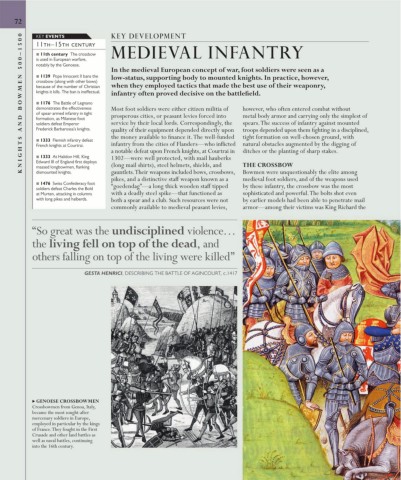
            ▶ GENOESE CROSSBOWMEN
            Crossbowmen from Genoa, Italy,
            became the most sought-after
            mercenary soldiers in Europe,
            employed in particular by the kings
            of France. They fought in the First
            Crusade and other land battles as
            well as naval battles, continuing
            into the 16th century.

