


Page 78 - (DK) Smithsinian - Military History: The Definitive Visual Guide to the Objects of Warfare
P. 78
76    MEDIEVAL ARCHERS

         WMEN 500–1500  Armies up to the Middle Ages made good use of archers, although the simple bows


            they used made firepower relatively limited. Crossbows became common for a time in
            the 12th and 13th centuries, but by the mid-14th century the English, in particular,
            were deploying a powerful new weapon—the longbow—whose greater range enabled
            them to nullify the advantage the armored knights possessed. As with most medieval
            men-at-arms, the archers used a range of daggers to defend themselves at close quarters,
            should their volleys be insufficient to drive off attackers.

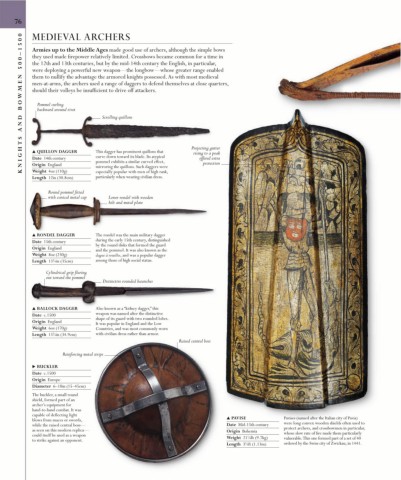
         AND BO  Pommel curling      Scrolling quillons
              backward around rivet


         KNIGHTS   ▲ QUILLON DAGGER  This dagger has prominent quillons that    Projecting gutter


                                                                      rising to a peak
                                   curve down toward its blade. Its atypical
                                                                        offered extra
            Date  14th century
                                   pommel exhibits a similar curved effect,
                                                                         protection
            Origin  England
            Weight  4oz (110g)
                                   especially popular with men of high rank,
                                   particularly when wearing civilian dress.
            Length  12in (30.8cm)  mirroring the quillons. Such daggers were
                  Round pommel fitted
                  with conical metal cap  Lower rondel with wooden
                                        hilt and metal plate


            ▲ RONDEL DAGGER        The rondel was the main military dagger
            Date  15th century     during the early 15th century, distinguished
                                   by the round disks that formed the guard
            Origin  England
                                   and the pommel. It was also known as the
            Weight  8oz (230g)     dague à rouelles, and was a popular dagger
                    3
            Length  13 ⁄4in (35cm)  among those of high social status.
                 Cylindrical grip flaring
                 out toward the pommel
                                      Distinctive rounded haunches


            ▲ BALLOCK DAGGER       Also known as a “kidney dagger,” this
            Date  c.1500           weapon was named after the distinctive
                                   shape of its guard with two rounded lobes.
            Origin  England
                                   It was popular in England and the Low
            Weight  6oz (170g)     Countries, and was most commonly worn
                    3
            Length  13 ⁄4in (34.9cm)  with civilian dress rather than armor.
                                                                 Raised central boss
                       Reinforcing metal strips

            ▶ BUCKLER
            Date  c.1500
            Origin  Europe
            Diameter  6–18in (15–45cm)
            The buckler, a small round
            shield, formed part of an
            archer’s equipment for
            hand-to-hand combat. It was
            capable of deflecting light
            blows from maces or swords,                                           ▲ PAVISE            Pavises (named after the Italian city of Pavia)
            while the raised central boss—                                        Date  Mid-15th century  were long convex wooden shields often used to
            as seen on this modern replica—                                       Origin  Bohemia     protect archers, and crossbowmen in particular,
            could itself be used as a weapon                                             1            whose slow rate of fire made them particularly
            to strike against an opponent.                                        Weight  21 ⁄4lb (9.7kg)  vulnerable. This one formed part of a set of 40
                                                                                        3
                                                                                  Length  3 ⁄4ft (1.13m)  ordered by the Swiss city of Zwickau, in 1441.

