


Page 77 - (DK) Smithsinian - Military History: The Definitive Visual Guide to the Objects of Warfare
P. 77
75


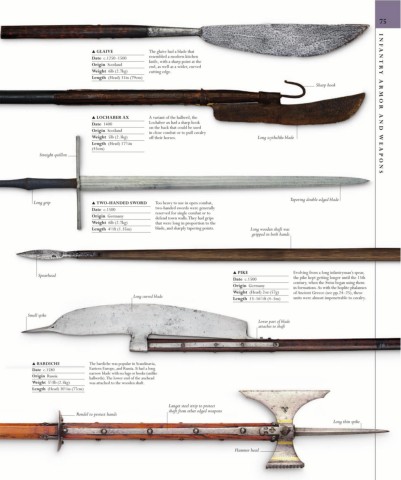
                                  ▲ GLAIVE            The glaive had a blade that                                                       INF
                                  Date  c.1250–1500   resembled a modern kitchen                                                        ANTR
                                                      knife, with a sharp point at the
                                  Origin  Scotland
                                                      end, as well as a wider, curved
                                  Weight  6lb (2.7kg)  cutting edge.
                                  Length  (Head) 31in (79cm)
                                                                                                                  Sharp hook


                                  ▲ LOCHABER AX       A variant of the halberd, the
                                  Date  1400          Lochaber ax had a sharp hook                                                      Y ARMOR AND  WEAPONS
                                                      on the back that could be used
                                  Origin  Scotland    in close combat or to pull cavalry
                                  Weight  5lb (2.3kg)  off their horses.                     Long scythelike blade
                                              3
                                  Length  (Head) 17 ⁄4in
                                  (45cm)
               Straight quillon


                                                                                                        Tapering double-edged blade
             Long grip            ▲ TWO-HANDED SWORD    Too heavy to use in open combat,
                                  Date  c.1500          two-handed swords were generally
                                                        reserved for single combat or to
                                  Origin  Germany
                                                        defend town walls. They had grips
                                  Weight  6lb (2.7kg)   that were long in proportion to the
                                        1
                                  Length  4 ⁄2ft (1.35m)  blade, and sharply tapering points.  Long wooden shaft was
                                                                                           gripped in both hands


                                                                                    ▲ PIKE                Evolving from a long infantryman’s spear,
              Spearhead
                                                                                    Date  c.1500          the pike kept getting longer until the 15th
                                                                                                          century, when the Swiss began using them
                                                                                    Origin  Germany
                                                                                                          in formations. As with the hoplite phalanxes
                                                                                    Weight  (Head) 2oz (57g)  of Ancient Greece (see pp.24–25), these
                                                Long curved blade
                                                                                              1
                                                                                    Length  13–16 ⁄2ft (4–5m)  units were almost impenetrable to cavalry.
           Small spike
                                                                                             Lower part of blade
                                                                                             attaches to shaft


            ▲ BARDICHE           The bardiche was popular in Scandinavia,
            Date  c.1580         Eastern Europe, and Russia. It had a long
                                 narrow blade with no lugs or hooks (unlike
            Origin  Russia
                                 halberds). The lower end of the axehead
                   1
            Weight  5 ⁄2lb (2.5kg)  was attached to the wooden shaft.
                        1
            Length  (Head) 30 ⁄4in (77cm)
                                                             Langet steel strip to protect
                                                             shaft from other edged weapons
                            Rondel to protect hands
                                                                                                                        Long thin spike


                                                                                     Hammer head

