


Page 75 - (DK) Smithsinian - Military History: The Definitive Visual Guide to the Objects of Warfare
P. 75
73


            Lionheart of England in 1199. Initially, these early   on the part of the archer. Its effectiveness
            European models were drawn by the bowman       depended upon an experienced archer
            bending forward, placing his foot in the stirrup at   who could loose around 17 arrows a
            the end of the stock, and attaching the string to a    minute. English kings discovered that
            hook on his belt; when he straightened his back,   by packing thousands of longbows                                         MEDIEV AL INF
            the string was drawn upward, “spanning” the    onto the battlefield, they could
            bow. From the 14th century onward, however,    produce a great density of fire—
            mechanisms were introduced—first a windlass    from a modern perspective, almost a
            and pulley, and later a ratchet known as a cranequin.  similar effect to that of the machine-
            These systems allowed the use of composite and   gun. The longbow saw spectacular
            steel bows of even greater strength: the effect of   successes in battle against the French,                                ANTR
            these weapons on the battlefield was awesome.   at Crécy in 1346, Poitiers in 1356, and
                                                           Agincourt in 1415.                                                           Y
            ARCHERS AND PIKEMEN                              A demonstration of the importance of
            The main drawback of the crossbow, however,    combining tactics with existing military       ▲ SALLET
            was its slow rate of fire. One or two shots a   technology was provided by the Swiss pikemen    The sallet, a form of helmet
            minute was the best an experienced bowman      in the late 15th century. The long pike was    introduced in the 15th century
                                                                                                          and widely used by infantry, gave
            could manage, and the crossbow was often a more   a supremely simple weapon, but the Swiss    excellent protection to the neck.
            effective weapon when used in sieges than on an   developed a new method of using it offensively,
            open battlefield. The longbow, on the other hand,   grouping their infantry together and fighting
            made a huge impact on European battlefields when   as massed columns of pikemen advancing
            deployed en masse by English armies in the 14th and  rapidly upon the enemy. Even more so than
            15th centuries. Preferably made of yew, the “self”   the introduction of gunpowder weapons, their
            bow (made from a single piece of wood) required   victories in the 1470s set the scene for a
            constant practice, as well as great physical strength,  new era in infantry warfare.


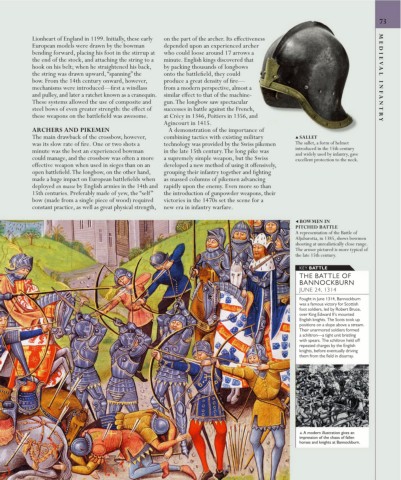
                                                                                                          ◀ BOWMEN IN
                                                                                                          PITCHED BATTLE
                                                                                                          A representation of the Battle of
                                                                                                          Aljubarotta, in 1385, shows bowmen
                                                                                                          shooting at unrealistically close range.
                                                                                                          The armor pictured is more typical of
                                                                                                          the late 15th century.


                                                                                                            KEY BATTLE
                                                                                                            THE BATTLE OF
                                                                                                            BANNOCKBURN
                                                                                                            JUNE 24, 1314
                                                                                                            Fought in June 1314, Bannockburn
                                                                                                            was a famous victory for Scottish
                                                                                                            foot soldiers, led by Robert Bruce,
                                                                                                            over King Edward II’s mounted
                                                                                                            English knights. The Scots took up
                                                                                                            positions on a slope above a stream.
                                                                                                            Their unarmored soldiers formed
                                                                                                            a schiltron—a tight unit bristling
                                                                                                            with spears. The schiltron held off
                                                                                                            repeated charges by the English
                                                                                                            knights, before eventually driving
                                                                                                            them from the field in disarray.


                                                                                                            ▲ A modern illustration gives an
                                                                                                            impression of the chaos of fallen
                                                                                                            horses and knights at Bannockburn.

