


Page 90 - (DK) Smithsinian - Military History: The Definitive Visual Guide to the Objects of Warfare
P. 90
88    SIEGE ENGINES AND EARLY CANNON

         WMEN 500–1500  During the Middle Ages, sieges were a far more common way of conducting


            warfare than open battle. Powerful siege engines that could batter fortification
            walls were used, allowing besieging armies to breach enemy defenses. The
            development of gunpowder weapons from the early 14th century onward
            increased the psychological aspect of siege warfare—the threat of devastation
            from this new form of firepower could drastically shorten a siege.


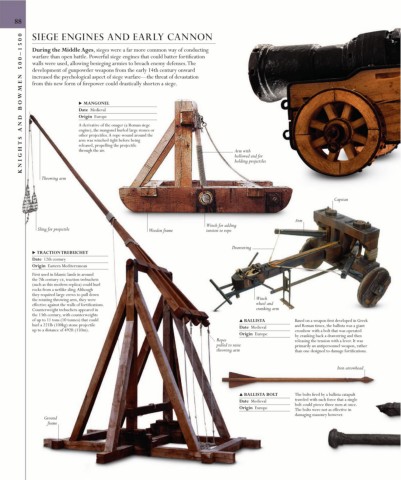
         AND BO              ▶ MANGONEL
                             Date  Medieval
                             Origin  Europe
                             A derivative of the onager (a Roman siege
                             engine), the mangonel hurled large stones or
         KNIGHTS             other projectiles. A rope wound around the              Arm with
                             arm was winched tight before being
                             released, propelling the projectile
                             through the air.
                                                                                     hollowed end for
                                                                                     holding projectiles


                Throwing arm


                                                                                                                        Capstan


                                                                                                          Arm
                                                                           Winch for adding
              Sling for projectile                    Wooden frame         tension to rope


                                                                                    Drawstring
            ▶ TRACTION TREBUCHET
            Date  12th century
            Origin  Eastern Mediterranean
            First used in Islamic lands in around
            the 7th century ce, traction trebuchets
            (such as this modern replica) could hurl
            rocks from a netlike sling. Although
            they required large crews to pull down
            the rotating throwing arm, they were                                            Winch
            effective against the walls of fortifications.                                  wheel and
            Counterweight trebuchets appeared in                                            cranking arm
            the 13th century, with counterweights
            of up to 11 tons (10 tonnes) that could                                   ▲ BALLISTA          Based on a weapon first developed in Greek
            hurl a 221lb (100kg) stone projectile                                     Date  Medieval      and Roman times, the ballista was a giant
            up to a distance of 492ft (150m).                                                             crossbow with a bolt that was operated
                                                                                      Origin  Europe      by cranking back a drawstring and then
                                                                              Ropes                       releasing the tension with a lever. It was
                                                                              pulled to raise             primarily an antipersonnel weapon, rather
                                                                              throwing arm                than one designed to damage fortifications.


                                                                                                                         Iron arrowhead


                                                                                      ▲ BALLISTA BOLT     The bolts fired by a ballista catapult
                                                                                      Date  Medieval      traveled with such force that a single
                                                                                                          bolt could pierce three men at once.
                                                                                      Origin  Europe      The bolts were not as effective in
                                                                                                          damaging masonry however.
                 Ground
                  frame

