


Page 142 - (DK Eyewitness) Travel Guide - India
P. 142
140 DELHI & THE NOR TH
Acclimatizing to Leh
Visitors flying into Leh,
situated at an altitude of
3,500 m (11,483 ft), should
allow themselves enough
time to acclimatize. Any
strenuous physical activity
should be avoided for at
least the first 24 hours.
During the first few days,
Leh’s high altitude can
often cause insomnia,
headaches, breathlessness
and loss of appetite.
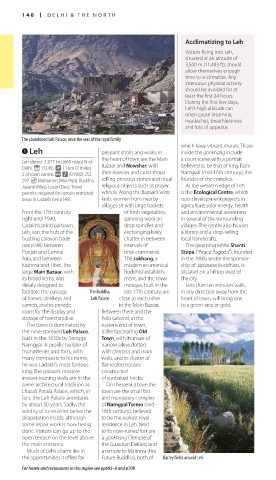
The abandoned Leh Palace, once the seat of the royal family
which have vibrant murals. Those
1 Leh pleasant strolls and walks. In inside the gonkhang include
the heart of town are the Main a court scene with a portrait
Leh district. 1,077 km (669 miles) N of
Delhi. * 15,000. ~ 11 km (7 miles) Bazaar and Nowshar, with believed to be that of King Tashi
S of town centre. @ n (01982) 252 their eateries and curio shops Namgyal (mid-16th century), the
297. _ Muharram (Mar/Apr), Buddha selling precious stones and ritual founder of the complex.
Jayanti (May), Losar (Dec). Travel religious objects such as prayer At the western edge of Leh
permits: required for certain restricted wheels. Along the Bazaar’s wide is the Ecological Centre, which
areas in Ladakh (see p146). kerb, women from nearby runs development projects in
villages sit with large baskets agriculture, solar energy, health
From the 17th century of fresh vegetables, and environmental awareness
right until 1949, spinning wool on in several of the surrounding
Ladakh’s principal town, drop spindles and villages. The centre also houses
Leh, was the hub of the exchanging lively a library and a shop selling
bustling caravan trade chatter in between local handicrafts.
(see p146) between intervals of The gleaming white Shanti
Punjab and Central brisk commerce. Stupa (“Peace Pagoda”), founded
Asia, and between The Jokhang, a in the 1980s under the sponsor-
Kashmir and Tibet. The modern ecumenical ship of Japanese Buddhists, is
large Main Bazaar, with Buddhist establish- situated on a hilltop west of
its broad kerbs, was ment, and the town the city.
clearly designed to mosque, built in the Less than ten minutes’ walk,
facilitate the passage The Buddha, late 17th century, are in any direction away from the
of horses, donkeys and Leh Palace close to each other heart of town, will bring one
camels, and to provide in the Main Bazaar. to a green area or gold,
room for the display and Between there and the
storage of merchandise. Polo Ground, at the
The town is dominated by eastern end of town,
the nine-storeyed Leh Palace, is the fascinating Old
built in the 1630s by Sengge Town, with its maze of
Namgyal. A prolific builder of narrow alleys dotted
monasteries and forts, with with chortens and mani
many conquests to his name, walls, and its cluster of
he was Ladakh’s most famous flat-roofed houses
king. The palace’s massive constructed
inward-leaning walls are in the of sunbaked bricks.
same architectural tradition as On the peak above the
Lhasa’s Potala Palace, which, in town are the small fort
fact, the Leh Palace antedates and monastery complex
by about 50 years. Sadly, the of Namgyal Tsemo (mid-
solidity of its exterior belies the 16th century), believed
dilapidation inside, although to be the earliest royal
some repair work is now being residence in Leh. Next
done. Visitors can go up to the to its now-ruined fort are
open terrace on the level above a gonkhang (Temple of
the main entrance. the Guardian Deities) and
Much of Leh’s charm lies in a temple to Maitreya (the
the opportunities it offers for Future Buddha), both of Barley fields around Leh
For hotels and restaurants in this region see pp695–6 and p708
140-141_EW_India.indd 140 26/04/17 11:43 am
Eyewitness Travel LAYERS PRINTED:
Catalogue template “UK” LAYER
(Source v2.6)
Date 12th July 2013
Size 125mm x 217mm

