


Page 146 - (DK Eyewitness) Travel Guide - India
P. 146
144 DELHI & THE NOR TH
The Oracles answer questions Namgyal dynasty. Of its several
put to them about public temples, the most rewarding is
and private affairs, and great the tshog-khang, a secondary
faith is reposed in their assembly hall that contains
predictions. Matho also has a fine image of the Buddha in
a small museum with a rare front of a huge silver chorten
collection of 16th-century set with flawless turquoises.
thangkas and costumes. Hemis is also renowned
for its spectacular annual
festival, dedicated to Guru
5 Hemis Monastery Padmasambhava, the 8th-
century Indian apostle who
Leh district. 43 km (27 miles) SE of Leh.
@ Open daily. & _ Annual Hemis took Buddhism to Tibet.
Festival (Jun). A unique feature of this festival,
which is held in the summer
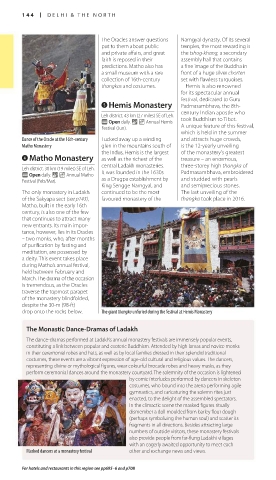
Dance of the Oracle at the 16th-century Tucked away up a winding and attracts huge crowds,
Matho Monastery glen in the mountains south of is the 12-yearly unveiling
the Indus, Hemis is the largest of the monastery’s greatest
4 Matho Monastery as well as the richest of the treasure – an enormous,
central Ladakh monasteries. three-storey high thangka of
Leh district. 30 km (19 miles) SE of Leh.
@ Open daily. & _ Annual Matho It was founded in the 1630s Padmasambhava, embroidered
Festival (Feb/Mar). as a Drugpa establishment by and studded with pearls
King Sengge Namgyal, and and semiprecious stones.
The only monastery in Ladakh continued to be the most The last unveiling of the
of the Sakyapa sect (see p143), favoured monastery of the thangka took place in 2016.
Matho, built in the early 16th
century, is also one of the few
that continues to attract many
new entrants. Its main impor-
tance, however, lies in its Oracles
– two monks, who, after months
of purification by fasting and
meditation, are possessed by
a deity. This event takes place
during Matho’s annual festival,
held between February and
March. The drama of the occasion
is tremendous, as the Oracles
traverse the topmost parapet
of the monastery blindfolded,
despite the 30-m (98-ft)
drop onto the rocks below. The giant thangka unfurled during the festival at Hemis Monastery
The Monastic Dance-Dramas of Ladakh
The dance-dramas performed at Ladakh’s annual monastery festivals are immensely popular events,
constituting a link between popular and esoteric Buddhism. Attended by high lamas and novice monks
in their ceremonial robes and hats, as well as by local families dressed in their splendid traditional
costumes, these events are a vibrant expression of age-old cultural and religious values. The dancers,
representing divine or mythological figures, wear colourful brocade robes and heavy masks, as they
perform ceremonial dances around the monastery courtyard. The solemnity of the occasion is lightened
by comic interludes performed by dancers in skeleton
costumes, who bound into the arena performing agile
gymnastics, and caricaturing the solemn rites just
enacted, to the delight of the assembled spectators.
In the climactic scene the masked figures ritually
dismember a doll moulded from barley flour dough
(perhaps symbolizing the human soul) and scatter its
fragments in all directions. Besides attracting large
numbers of outside visitors, these monastery festivals
also provide people from far-flung Ladakhi villages
with an eagerly awaited opportunity to meet each
Masked dancers at a monastery festival other and exchange news and views.
For hotels and restaurants in this region see pp695–6 and p708
144-145_EW_India.Indd 144 26/04/17 11:43 am
Eyewitness Travel LAYERS PRINTED:
Catalogue template “UK” LAYER
(Source v2.4)
Date 25th April 2013
Size 125mm x 217mm

