


Page 148 - (DK Eyewitness) Travel Guide - India
P. 148
146 DELHI & THE NOR TH
crane, bar-headed geese and
the great crested grebe. Wild
asses, marmots and foxes can
also be seen in the region.
Among the human inhabitants
of Southeast Ladakh are the
nomadic herders, known as
Chang-pa, who brave extreme
cold (-40° C/-40° F in winter, and
freezing nights even in summer)
throughout the year, living in
their black yak-hair tents. They
raise yak and sheep, but their
main wealth is the pashmina
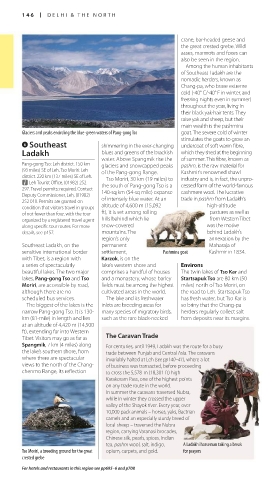
Glaciers and peaks encircling the blue-green waters of Pang-gong Tso goat. The severe cold of winter
stimulates the goats to grow an
6 Southeast shimmering in the ever-changing undercoat of soft warm fibre,
Ladakh blues and greens of the brackish which they shed at the beginning
water. Above Spangmik rise the of summer. This fibre, known as
Pang-gong Tso: Leh district. 150 km glaciers and snowcapped peaks pashm, is the raw material for
(93 miles) SE of Leh. Tso Moriri: Leh of the Pang-gong Range. Kashmir’s renowned shawl
district. 220 km (137 miles) SE of Leh. Tso Moriri, 30 km (19 miles) to industry and is, in fact, the unpro-
n Leh Tourist Office, (01982) 252 the south of Pang-gong Tso is a cessed form of the world-famous
297. Travel permits: required. Contact
Deputy Commissioner, Leh, (01982) 140-sq km (54-sq mile) expanse cashmere wool. The lucrative
252 010. Permits are granted on of intensely blue water. At an trade in pashm from Ladakh’s
condition that visitors travel in groups altitude of 4,600 m (15,092 high-altitude
of not fewer than four, with the tour ft), it is set among rolling pastures as well as
organized by a registered travel agent hills behind which lie from Western Tibet
along specific tour routes. For more snow-covered was the motive
details, see p157. mountains. The behind Ladakh’s
region’s only annexation by the
Southeast Ladakh, on the permanent Maharaja of
sensitive international border settlement, Pashmina goat Kashmir in 1834.
with Tibet, is a region with Karzok, is on the
a series of spectacularly lake’s western shore and Environs
beautiful lakes. The two major comprises a handful of houses The twin lakes of Tso Kar and
lakes, Pang-gong Tso and Tso and a monastery, whose barley Startsapuk Tso are 80 km (50
Moriri, are accessible by road, fields must be among the highest miles) north of Tso Moriri, on
although there are no cultivated areas in the world. the road to Leh. Startsapuk Tso
scheduled bus services. The lake and its freshwater has fresh water, but Tso Kar is
The biggest of the lakes is the inlets are breeding areas for so briny that the Chang-pa
narrow Pang-gong Tso. It is 130- many species of migratory birds, herders regularly collect salt
km (81-mile) in length and lies such as the rare black-necked from deposits near its margins.
at an altitude of 4,420 m (14,500
ft), extending far into Western
Tibet. Visitors may go as far as The Caravan Trade
Spangmik, 7 km (4 miles) along For centuries, until 1949, Ladakh was the route for a busy
the lake’s southern shore, from trade between Punjab and Central Asia. The caravans
where there are spectacular invariably halted at Leh (see pp140–41), where a lot
views to the north of the Chang- of business was transacted, before proceeding
chenmo Range, its reflection to cross the 5,578-m (18,301-ft) high
Karakoram Pass, one of the highest points
on any trade route in the world.
In summer the caravans traversed Nubra,
while in winter they crossed the upper
valley of the Shayok river. Every year, over
10,000 pack animals – horses, yaks, Bactrian
camels and an especially sturdy breed of
local sheep – traversed the Nubra
region, carrying Varanasi brocades,
Chinese silk, pearls, spices, Indian
tea, pashm wool, salt, indigo, A Ladakhi horseman taking a break
Tso Moriri, a breeding ground for the great opium, carpets, and gold. for prayers
crested grebe
For hotels and restaurants in this region see pp695–6 and p708
146-147_EW_India.indd 146 26/04/17 11:43 am
Eyewitness Travel LAYERS PRINTED:
Catalogue template “UK” LAYER
(Source v2.6)
Date 12th July 2013
Size 125mm x 217mm

