


Page 157 - (DK Eyewitness) Travel Guide - India
P. 157
LAD AKH , JA MMU & K ASHMIR 155
sites to explore in the vicinity.
Within easy reach on foot is the
village of Pipiting, which has a
temple and chorten (stupa) on
top of a mound of glacial debris,
and a pavilion that was specially
constructed for the Dalai Lama’s
prayer assemblies.
A short distance away is
Sani, 8 km (5 miles) northwest
of Padum, one of the oldest
religious sites in the Western
Himalayas. Within the monastery
walls stands the Kanika Chorten,
its name possibly linking it to
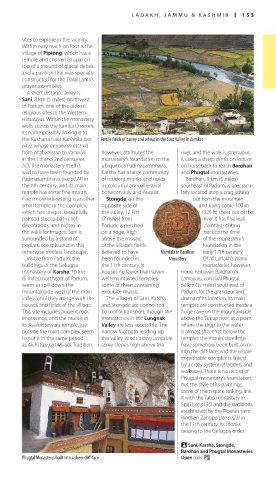
the Kushana ruler Kanishka (see Fertile fields of barley and wheat in the Stod Valley in Zanskar
p47), whose empire stretched
from Afghanistan to Varanasi however, attributes the river, and the walk is strenuous.
in the 1st and 2nd centuries monastery’s foundation to the It takes a sharp climb on foot or
AD. The monastery itself is ubiquitous Padmasambhava. on horseback to reach Bardhan
said to have been founded by Karsha has a large community and Phugtal monasteries.
Padmasambhava (see p124) in of resident monks and holds Bardhan, 9 km (6 miles)
the 8th century, and its main its colourful annual festival southeast of Padum, is spec tacu-
temple has some fine murals. between July and August. larly located atop a crag jutting
Even more interesting is another Stongde, on the out from the mountain
small temple in the complex, opposite side of and rising some 100 m
which has unique, beautifully the valley, 12 km (328 ft) sheer out of the
painted stucco bas-relief (7 miles) from river. It has fine wall
deco rations, and niches in Padum, is perched paintings dating
the walls for images. Sani is on a ridge, high back to the time
surrounded by a stand of above the mosaic of the monastery’s
poplars, conspicuous in this of the village’s fields. foundation in the
otherwise treeless landscape. Believed to have Mandala in Bardhan early 17th century.
Visible from Padum, the been founded in Monastery Of all Ladakh’s many
buildings of the Gelugpa the 11th century, it monasteries however,
monastery of Karsha, 10 km houses no fewer than seven none, not even Bardhan or
(6 miles) northeast of Padum, well-maintained temples, Lamayuru, can rival Phugtal,
seem to spill down the some of them containing 60 km (37 miles) southeast of
mountainside west of the main exquisite murals. Padum, for the grandeur and
valley, until they merge with the The villages of Sani, Karsha drama of its location. Its main
houses and fields of the village. and Stongde are connected temples are constructed inside a
This site includes ancient rock by motor transport, though the huge cave on the mountainside
engravings, and the murals in monasteries in the Lungnak above the Tsarap river, at a point
its Avalokitesvara temple, just Valley are less accessible. The where the drop to the water
outside the main complex, seem narrow footpath leading up is almost sheer. Yet below the
to put it in the same period the valley winds along unstable temples the monks’ dwellings
as Alchi (see pp148–50). Tradition, scree slopes high above the have somehow been built on or
into the cliff-face, and the whole
improbable complex is linked
by a crazy system of ladders and
walkways. There is no record of
Phugtal monastery’s foundation,
but the style of its paintings,
some of them quite striking, link
it with the Tabo monastery in
Spiti (see p135) and the traditions
established by the Tibetan saint
Rinchen Zangpo (see p123) in
the 11th century. Its monks
belong to the Gelugpa order.
Sani, Karsha, Stongde,
Bardhan and Phugtal Monasteries
Phugtal Monastery, built into a sheer cliff-face Open daily. &
154-155_EW_India.indd 155 26/04/17 11:43 am

