


Page 152 - (DK Eyewitness) Travel Guide - India
P. 152
150 DELHI & THE NOR TH
Exploring Alchi Monastery
Unknown to the outside world until 1974, when Ladakh
was opened up to tourists, Alchi is now one of the region’s
major attractions, renowned as a great centre of Buddhist
art. It was built as a monument to the Second Spreading –
the revival of Buddhism that took place in Tibet in the
11th century, on the basis of religious texts brought from
Kashmir. The entire Mahayana Buddhist pantheon of deities
is represented within its five temples, together with superb
paintings of court life, battles and pilgrimages, depicting
the costumes, architecture and customs of the time.
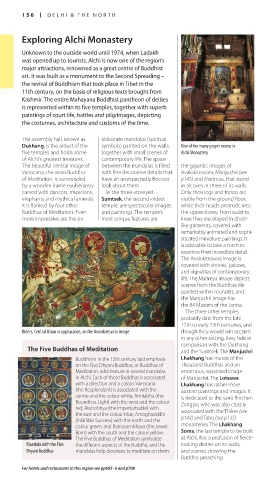
The assembly hall, known as elaborate mandalas (spiritual
Dukhang, is the oldest of the symbols) painted on the walls, One of the many prayer rooms in
five temples and holds some together with small scenes of Alchi Monastery
of Alchi’s greatest treasures. contemporary life. The space
The beautiful central image of between the mandalas is filled the gigantic images of
Vairocana, the main Buddha with fine decorative details that Avalokitesvara, Manjushri (see
of Meditation, is surrounded have an unexpectedly Rococo p145) and Maitreya, that stand
by a wooden frame exuberantly look about them. in alcoves in three of its walls.
carved with dancers, musicians, In the three-storeyed Only their legs and torsos are
elephants and mythical animals. Sumtsek, the second-oldest visible from the ground floor,
It is flanked by four other temple, are spectacular images while their heads protrude into
Buddhas of Meditation. Even and paintings. The temple’s the upper storey. From waist to
more impressive are the six most unique features are knee they are draped in dhoti-
like garments, covered with
remarkably animated and sophi-
sticated miniature paintings. It
is advisable to take a torch to
examine their incredible detail.
The Avaloki tesvara image is
covered with shrines, palaces,
and vignettes of contemporary
life. The Maitreya image depicts
scenes from the Buddha’s life
painted within roundels, and
the Manjushri image has
the 84 Masters of the Tantra.
The three other temples
probably date from the late
12th to early 13th centuries, and
Riders, Central Asian in appearance, on the Avalokitesvara image though they would win acclaim
in any other setting, they fade in
comparison with the Dukhang
The Five Buddhas of Meditation and the Sumtsek. The Manjushri
Buddhism in the 12th century laid emphasis Lhakhang has murals of the
on the Five Dhyani Buddhas, or Buddhas of Thousand Buddhas and an
Meditation, who feature in several mandalas enormous, repainted image
in Alchi. Each of these Buddhas is associated of Manjushri. The Lotsawa
with a direction and a colour. Vairocana Lhakhang has rather more
(the Resplendent) is associated with the austere paintings and images. It
centre and the colour white; Amitabha (the is dedicated to the saint Rinchen
Boundless Light) with the west and the colour Zangpo, who was also closely
red; Akshobhya (the Imperturbable) with associated with the Thikse (see
the east and the colour blue; Amoghasiddhi
(Infallible Success) with the north and the p143) and Tabo (see p135)
colour green; and Ratnasambhava (the Jewel- monasteries. The Lhakhang
Born) with the south and the colour yellow. Soma, the last temple to be built
The Five Buddhas of Meditation symbolize at Alchi, has a profusion of fierce-
Mandala with the Five the different aspects of the Buddha, and the looking deities on its walls,
Dhyani Buddhas mandalas help devotees to meditate on them. and scenes showing the
Buddha preaching.
For hotels and restaurants in this region see pp695–6 and p708
150-151_EW_India.indd 150 26/04/17 11:43 am
Eyewitness Travel LAYERS PRINTED:
Catalogue template “UK” LAYER
(Source v2.6)
Date 12th July 2013
Size 125mm x 217mm

