


Page 234 - (DK Eyewitness) Travel Guide - India
P. 234
232 CENTR AL INDIA
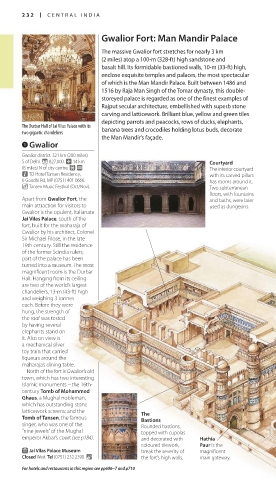
Gwalior Fort: Man Mandir Palace
The massive Gwalior fort stretches for nearly 3 km
(2 miles) atop a 100-m (328-ft) high sandstone and
basalt hill. Its formidable bastioned walls, 10-m (33-ft) high,
enclose exquisite temples and palaces, the most spectacular
of which is the Man Mandir Palace. Built between 1486 and
1516 by Raja Man Singh of the Tomar dynasty, this double-
storeyed palace is regarded as one of the finest examples of
Rajput secular architecture, embellished with superb stone
carving and latticework. Brilliant blue, yellow and green tiles
depicting parrots and peacocks, rows of ducks, elephants,
The Durbar Hall of Jai Vilas Palace with its
two gigantic chandeliers banana trees and crocodiles holding lotus buds, decorate
the Man Mandir’s façade.
1 Gwalior
Gwalior district. 321 km (200 miles)
S of Delhi. * 827,000. ~ 14 km Courtyard
(8 miles) N of city centre. £ @ The interior court yard
n TO Hotel Tansen Residency, with its carved pillars
6 Gandhi Rd, MP (0751) 401 0666. has rooms around it.
_ Tansen Music Festival (Oct/Nov). Two subterranean
floors, with fountains
Apart from Gwalior Fort, the and baths, were later
main attraction for visitors to used as dungeons.
Gwalior is the opulent, Italianate
Jai Vilas Palace, south of the
fort, built for the maharaja of
Gwalior by his architect, Colonel
Sir Michael Filose, in the late
19th century. Still the residence
of the former Scindia rulers,
part of the palace has been
turned into a museum. The most
magnificent room is the Durbar
Hall. Hanging from its ceiling
are two of the world’s largest
chandeliers, 13-m (43-ft) high
and weighing 3 tonnes
each. Before they were
hung, the strength of
the roof was tested
by having several
elephants stand on
it. Also on view is
a mechanical silver
toy train that carried
liqueurs around the
maharaja’s dining table.
North of the fort is Gwalior’s old
town, which has two interesting
Islamic monuments – the 16th-
century Tomb of Mohammed
Ghaus, a Mughal nobleman,
which has outstanding stone
latticework screens; and the The
Tomb of Tansen, the famous Bastions
singer, who was one of the Rounded bastions,
“nine jewels” of the Mughal topped with cupolas
emperor Akbar’s court (see p184). and decorated with Hathia
coloured tilework, Paur is the
E Jai Vilas Palace Museum break the severity of magnificent
Closed Wed. Tel (0751) 232 2390. & the fort’s high walls. main gateway.
For hotels and restaurants in this region see pp696–7 and p710
232-233_EW_India.indd 232 26/04/17 11:44 am
Eyewitness Travel LAYERS PRINTED:
Catalogue template “UK” LAYER
(Source v2.6)
Date 12th July 2013
Size 125mm x 217mm

