


Page 26 - (DK Eyewitness) Travel Guide - India
P. 26
24 INTRODUCING INDIA
Sacred Architecture
India’s 2,000-year-old architectural heritage is
intrinsically linked to the country’s major religions.
Indigenous forms include Buddhist stupas and
monasteries and Hindu and Jain temples (see pp400–
401) in diverse styles. Many Indian temples, however,
share common structural characteristics, being mostly
built of stone columns and horizontal blocks, often
richly carved with sacred imagery and decorative
motifs. The true arch and the dome, as well as the use
of mortar, were introduced in the 12th century with Detail on a sculpted column, Narayana
the establishment of the Delhi Sultanate. Temple, Melkote
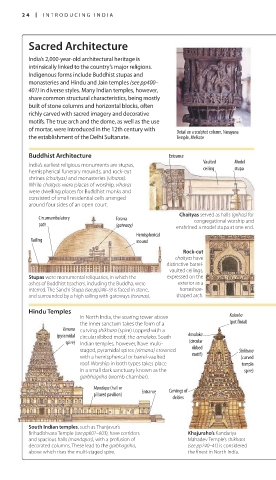
Buddhist Architecture Entrance
Vaulted Model
India’s earliest religious monuments are stupas, ceiling stupa
hemispherical funerary mounds, and rock-cut
shrines (chaityas) and monasteries (viharas).
While chaityas were places of worship, viharas
were dwelling places for Buddhist monks and
consisted of small residential cells arranged
around four sides of an open court.
Chaityas served as halls (grihas) for
Circumambulatory Torana congregational worship and
path (gateway) enshrined a model stupa at one end.
Hemispherical
Railing mound
Rock-cut
chaityas have
distinctive barrel-
vaulted ceilings,
Stupas were monumental reliquaries, in which the expressed on the
ashes of Buddhist teachers, including the Buddha, were exterior as a
interred. The Sanchi Stupa (see pp248–9) is faced in stone, horseshoe-
and surrounded by a high railing with gateways (toranas). shaped arch.
Hindu Temples
In North India, the soaring tower above Kalasha
the inner sanctum takes the form of a (pot finial)
Vimana curving shikhara (spire) topped with a
(pyramidal circular ribbed motif, the amalaka. South Amalaka
spire) Indian temples, however, have multi- (circular
staged, pyramidal spires (vimana) crowned ribbed Shikhara
with a hemispherical or barrel-vaulted motif) (curved
roof. Worship in both types takes place temple
in a small dark sanctuary known as the spire)
garbhagriha (womb chamber).
Mandapa (hall or Carvings of
pillared pavilion) Entrance deities
South Indian temples, such as Thanjavur’s
Brihadishvara Temple (see pp602–603), have corridors Khajuraho’s Kandariya
and spacious halls (mandapas), with a profusion of Mahadev Temple’s shikhara
decorated columns. These lead to the garbhagriha, (see pp240–41) is considered
above which rises the multi-staged spire. the finest in North India.
024-025_EW_India.indd 24 26/04/17 11:52 am

