


Page 29 - (DK Eyewitness) Travel Guide - India
P. 29
A POR TR AIT OF INDIA 27
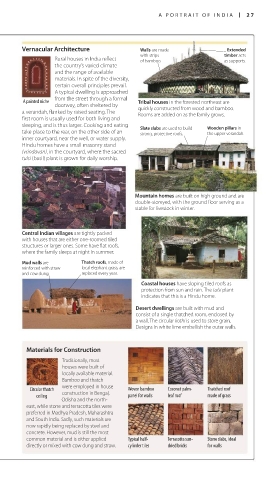
Vernacular Architecture Walls are made Extended
with strips timber acts
Rural houses in India reflect of bamboo. as supports.
the country’s varied climate
and the range of available
materials. In spite of the diversity,
certain overall principles prevail.
A typical dwelling is approached
from the street through a formal
A painted niche Tribal houses in the forested northeast are
doorway, often sheltered by quickly constructed from wood and bamboo.
a verandah, flanked by raised seating. The Rooms are added on as the family grows.
first room is usually used for both living and
sleeping, and is thus larger. Cooking and eating Slate slabs are used to build Wooden pillars in
take place to the rear, on the other side of an strong, protective roofs. the upper verandah.
inner courtyard, near the well, or water supply.
Hindu homes have a small masonry stand
(vrindavan), in the courtyard, where the sacred
tulsi (basil) plant is grown for daily worship.
Mountain homes are built on high ground and are
double-storeyed, with the ground floor serving as a
stable for livestock in winter.
Central Indian villages are tightly packed
with houses that are either one-roomed tiled
structures or larger ones. Some have flat roofs,
where the family sleeps at night in summer.
Mud walls are Thatch roofs, made of
reinforced with straw local elephant grass, are
and cow dung. replaced every year.
Coastal houses have sloping tiled roofs as
protection from sun and rain. The tulsi plant
indicates that this is a Hindu home.
Desert dwellings are built with mud and
consist of a single thatched room, enclosed by
a wall. The circular kothi is used to store grain.
Designs in white lime embellish the outer walls.
Materials for Construction
Traditionally, most
houses were built of
locally available material.
Bamboo and thatch
were employed in house
Circular thatch Woven bamboo Coconut palm- Thatched roof
ceiling construction in Bengal, panel for walls leaf roof made of grass
Odisha and the north-
east, while stone and terracotta tiles were
preferred in Madhya Pradesh, Maharashtra
and South India. Sadly, such materials are
now rapidly being replaced by steel and
concrete. However, mud is still the most
common material and is either applied Typical half- Terracotta sun- Stone slabs, ideal
directly or mixed with cow dung and straw. cylinder tiles dried bricks for walls
026-027_EW_India.indd 27 26/04/17 11:42 am

