


Page 28 - (DK Eyewitness) Travel Guide - India
P. 28
26 INTRODUCING INDIA
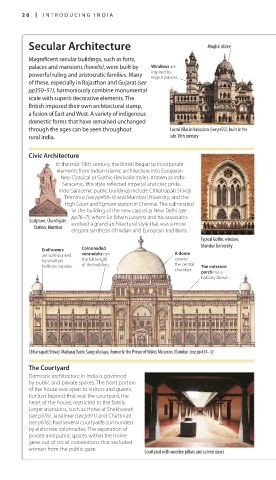
Secular Architecture Mughal dome
Magnificent secular buildings, such as forts,
palaces and mansions (havelis), were built by Windows are
powerful ruling and aristocratic families. Many inspired by
Rajput palaces.
of these, especially in Rajasthan and Gujarat (see
pp350–51), harmoniously combine monumental
scale with superb decorative elements. The
British imposed their own architectural stamp,
a fusion of East and West. A variety of indigenous
domestic forms that have remained unchanged
through the ages can be seen throughout Laxmi Vilas in Vadodara (see p422), built in the
rural India. late 19th century
Civic Architecture
In the mid-19th century, the British began to incorporate
elements from Indian Islamic architecture into European
Neo-Classical or Gothic-Revivalist styles. Known as Indo-
Saracenic, this style reflected imperial and civic pride.
Indo-Saracenic public buildings include Chhatrapati Shivaji
Terminus (see pp458–9) and Mumbai University, and the
High Court and Egmore station in Chennai. This culminated
in the building of the new capital at New Delhi (see
pp76–7), where Sir Edwin Lutyens and his associates
Sculpture, Churchgate evolved a grand architectural style that was a more
Station, Mumbai
elegant synthesis of Indian and European traditions.
Typical Gothic window,
Mumbai University
End towers Colonnaded
are surmounted verandahs run A dome
by small yet the full length crowns
bulbous cupolas. of the building. the central The entrance
chamber. porch has a
balcony above.
Chhatrapati Shivaji Maharaj Vastu Sangrahalaya, formerly the Prince of Wales Museum, Mumbai (see pp454–5)
The Courtyard
Domestic architecture in India is governed
by public and private spaces. The front portion
of the house was open to visitors and guests,
but just beyond that was the courtyard, the
heart of the house, restricted to the family.
Larger mansions, such as those at Shekhawati
(see p376), Jaisalmer (see p391) and Chettinad
(see p616), had several courtyards surrounded
by elaborate colonnades. The separation of
private and public spaces within the home
grew out of social conventions that secluded
women from the public gaze. Courtyard with wooden pillars and carved doors
026-027_EW_India.indd 26 26/04/17 11:42 am
Eyewitness Travel LAYERS PRINTED:
Feature template “UK” LAYER
(SourceReport v1.3)
Date 18th October 2012
Size 125mm x 217mm

