


Page 393 - (DK Eyewitness) Travel Guide - India
P. 393
R A JASTHAN 391
The Jaisalmer Haveli
After the fort, Jaisalmer’s havelis are its greatest attraction. Built in the 19th century by
the town’s merchants and ministers, these mansions dominate its labyrinthine lanes.
The havelis of Salim Singh, Nathmalji and Patwon are the finest examples of this type
of architecture, their golden stone façades so finely carved that they could be made
of lace. Several generations of an extended family lived together in these huge mansions,
which usually contained secluded women’s quarters that outsiders could not enter.
Jaisalmer’s stonemasons still practise their art, doing restoration work in the fort, and
working abroad for wealthy new patrons in the Gulf and Saudi Arabia.
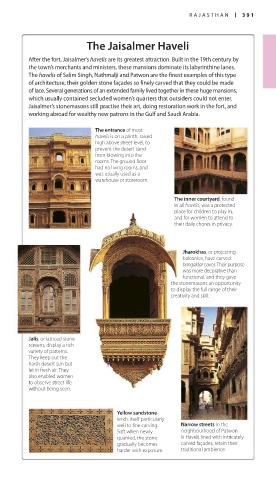
The entrance of most
havelis is on a plinth, raised
high above street level, to
prevent the desert sand
from blowing into the
rooms. The ground floor
had no living rooms, and
was usually used as a
warehouse or storeroom.
The inner courtyard, found
in all havelis, was a protected
place for children to play in,
and for women to attend to
their daily chores in privacy.
Jharokhas, or projecting
balconies, have curved
bangaldar eaves. Their purpose
was more decorative than
functional, and they gave
the stonemasons an opportunity
to display the full range of their
creativity and skill.
Jalis, or latticed stone
screens, display a rich
variety of patterns.
They keep out the
harsh desert sun but
let in fresh air. They
also enabled women
to observe street life
without being seen.
Yellow sandstone
lends itself particularly
well to fine carving. Narrow streets in the
Soft when newly neighbourhood of Patwon
quarried, the stone ki Haveli, lined with intricately
gradually becomes carved façades, retain their
harder with exposure. traditional ambience.
390-391_EW_India.indd 391 26/04/17 11:54 am

