


Page 394 - (DK Eyewitness) Travel Guide - India
P. 394
392 WESTERN INDIA
Jaisalmer Fort
Jaisalmer Fort rises like a fabulous mirage out of the sands
of the Thar Desert, the awesome contours of its 99 bastions
softened by the golden hue of the stone. Built in 1156 by
Maharawal Jaisal, and added to by his successors, this citadel
stands on the peak of the 80-m (262-ft) high Trikuta Hill. In
medieval times, Jaisalmer’s entire pop ulation lived within the
fort and even now, thousands of people reside here, making it
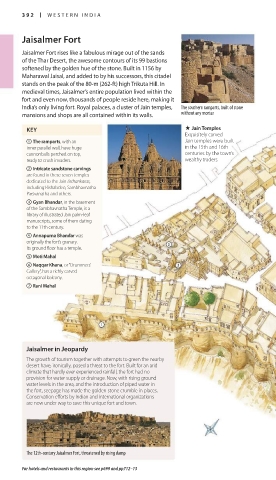
India’s only living fort. Royal palaces, a cluster of Jain temples, The southern ramparts, built of stone
mansions and shops are all contained within its walls. without any mortar
KEY . Jain Temples
Exquisitely carved
1 The ramparts, with an Jain temples were built
inner parallel wall, have huge in the 15th and 16th
cannonballs perched on top, centuries by the town’s
ready to crush invaders. wealthy traders.
2 Intricate sandstone carvings
are found in these seven temples
dedicated to the Jain tirthankaras,
including Rishabdeo, Sambhavnatha
Parsvanatha and others.
3 Gyan Bhandar, in the basement
of the Sambhavnatha Temple, is a
library of illustrated Jain palm-leaf
manuscripts, some of them dating
to the 11th century.
4 Annapurna Bhandar was
originally the fort’s granary.
Its ground floor has a temple.
5 Moti Mahal
6 Naqqar Khana, or “Drummers’
Gallery”, has a richly carved
octagonal balcony.
7 Rani Mahal
Jaisalmer in Jeopardy
The growth of tourism together with attempts to green the nearby
desert have, ironically, posed a threat to the fort. Built for an arid
climate that hardly ever experienced rainfall, the fort had no
provision for water supply or drainage. Now, with rising ground
water levels in the area, and the introduction of piped water in
the fort, seepage has made the golden stone crumble in places.
Conservation efforts by Indian and international organizations
are now under way to save this unique fort and town.
The 12th-century Jaisalmer Fort, threatened by rising damp
For hotels and restaurants in this region see p699 and pp712–13
392-393_EW_India.indd 392 26/04/17 11:46 am
Eyewitness Travel LAYERS PRINTED:
Starsight template “UK” LAYER
(Source v2.7)
Date 24th April 2013
Size 125mm x 217mm

