


Page 522 - (DK Eyewitness) Travel Guide - India
P. 522
520 SOUTHWESTERN INDIA
through a doorway with 4 Srirangapattana
an open portico, where a Mandya district. 16 km (10 miles)
slab records Somnatha’s N of Mysuru. Tel (08232) 238 377.
generous donations. Unlike £ from Mysuru. @ from Mysore.
the other Hoysala temples Autos and cycles available.
at Halebid and Belur (see
p527), this is well preserved Known to the British as
and has complete towers. Seringapatam, this island
The temple has three star fortress in the Kaveri river enjoys
shaped shrines that lead historical significance as the
off a pillared hall; both the site of the battles between
shrines and the hall stand the British and Tipu Sultan, the
on a high plinth. The “Tiger of Mysore”. The British
basements of the inner finally stormed the citadel in
sanctums and hall are 1799, killing Tipu and consolida
profusely carved with ting their power in South India.
animal and floral patterns, Today, none of the structures
while images of deities within the fort survives, barring
under foliage canopies the bridges across the two arms
occupy the walls above. of the Kaveri river, from which
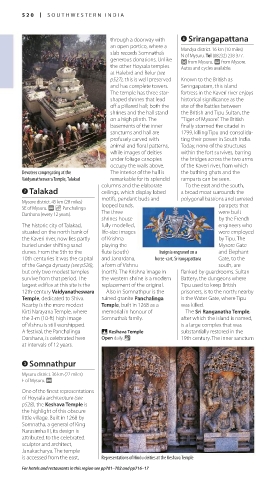
Devotees congregating at the The interior of the hall is the bathing ghats and the
Vaidyanatheswara Temple, Talakad remarkable for its splendid ramparts can be seen.
columns and the elaborate To the east and the south,
2 Talakad ceilings, which display lobed a broad moat surrounds the
motifs, pendant buds and polygonal bastions and turreted
Mysore district. 45 km (28 miles)
SE of Mysuru. @ _ Panchalinga looped bands. parapets that
Darshana (every 12 years). The three were built
shrines house by the French
The historic city of Talakad, fully modelled, engineers who
situated on the north bank of lifesize images were employed
the Kaveri river, now lies partly of Krishna by Tipu. The
buried under shifting sand playing the Mysore Gate
dunes. From the 5th to the flute (south) Insignia engraved on a and Elephant
10th centuries it was the capital and Janardana, horse-cart, Srirangapattana Gate, to the
of the Ganga dynasty (see p526), a form of Vishnu south, are
but only two modest temples (north). The Krishna image in flanked by guardrooms. Sultan
survive from that period. The the western shrine is a modern Battery, the dungeons where
largest edifice at this site is the replacement of the original. Tipu used to keep British
12thcentury Vaidyanatheswara Also in Somnathpur is the prisoners, is to the north; nearby
Temple, dedicated to Shiva. ruined granite Panchalinga is the Water Gate, where Tipu
Nearby is the more modest Temple, built in 1268 as a was killed.
Kirti Narayana Temple, where memorial in honour of The Sri Ranganatha Temple,
the 3m (10ft) high image Somnatha’s family. after which the island is named,
of Vishnu is still worshipped. is a large complex that was
A festival, the Panchalinga Keshava Temple substantially restored in the
Darshana, is celebrated here Open daily. & 19th century. The inner sanctum
at intervals of 12 years.
3 Somnathpur
Mysuru district. 36 km (22 miles)
E of Mysuru. @
One of the finest repre sentations
of Hoysala architecture (see
p528), the Keshava Temple is
the highlight of this obscure
little village. Built in 1268 by
Somnatha, a general of King
Narasimha III, its design is
attributed to the celebrated
sculptor and architect,
Janakacharya. The temple
is accessed from the east, Representations of Hindu deities at the Keshava Temple
For hotels and restaurants in this region see pp701–702 and pp716–17
520-521_EW_India.indd 520 26/04/17 11:55 am

