


Page 523 - (DK Eyewitness) Travel Guide - India
P. 523
K ARNA T AK A 521
Festivals in
Karnataka
Banashankari Temple
Fair (Jan/Feb), Badami.
This 20-day festival
combines religious rites
with the excitement of
a funfair. An annual cattle
fair, specializing in white
bulls, is held at the
same time.
Royal Dasara (Sep/Oct),
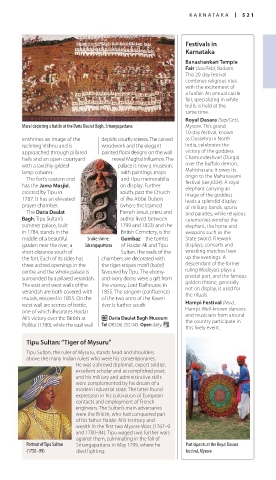
Mural depicting a battle at the Daria Daulat Bagh, Srirangapattana Mysore. This grand
10-day festival, known
enshrines an image of the depicts courtly scenes. The carved as Dussehra in North
reclining Vishnu and is wood work and the elegant India, celebrates the
approached through pillared painted floral designs on the wall victory of the goddess
halls and an open courtyard reveal Mughal influence. The Chamundeshvari (Durga)
with a lavishly gilded palace is now a museum, over the buffalo demon,
lamp column. with paintings, maps Mahisha sura; it owes its
The fort’s eastern end and Tipu memorabilia origin to the Mahanavami
festival (see p534). A royal
has the Jama Masjid, on display. Further elephant carrying an
erected by Tipu in south, past the Church image of the goddess
1787. It has an elevated of the Abbé Dubois leads a splendid display
prayer chamber. (where the learned of military bands, sports
The Daria Daulat French Jesuit priest and and parades, while religious
Bagh, Tipu Sultan’s author lived between ceremonies worship the
summer palace, built 1799 and 1823) and the elephant, the horse and
in 1784, stands in the British Cemetery, is the weapons such as the
middle of a beautiful Snake shrine, Gumbaz – the tombs State sword. Firework
garden near the river, a Srirangapattana of Haidar Ali and Tipu displays, concerts and
short distance south of Sultan. The walls of the wrestling matches liven
the fort. Each of its sides has chambers are decorated with up the evenings. A
three arched openings in the the tiger-stripes motif (bubri) descendant of the former
centre and the whole palace is favoured by Tipu. The ebony- ruling Wodeyars plays a
surrounded by a pillared verandah. and-ivory doors were a gift from pivotal part, and the famous
The east and west walls of the the viceroy, Lord Dalhousie, in golden throne, generally
not on display, is used for
verandah are both covered with 1855. The sangam (confluence) the rituals.
murals, restored in 1855. On the of the two arms of the Kaveri
west wall are scenes of battle, river is further south. Hampi Festival (Nov),
one of which illustrates Haidar Hampi. Well-known dan cers
and musicians from around
Ali’s victory over the British at E Daria Daulat Bagh Museum the country participate in
Pollilur (1780), while the east wall Tel (08326) 252 045. Open daily. & this lively event.
Tipu Sultan: “Tiger of Mysuru”
Tipu Sultan, the ruler of Mysuru, stands head and shoulders
above the many Indian rulers who were his contemporaries.
He was a shrewd diplomat, expert soldier,
excellent scholar and accomplished poet,
and his military and administrative skills
were complemented by his dream of a
modern industrial state. The latter found
expression in his cultivation of European
contacts and employment of French
engineers. The Sultan’s main adversaries
were the British, who had conquered part
of his father Haider Ali’s territory and
wealth in the first two Mysore Wars (1767–9
and 1780–84). Tipu waged two further wars
against them, culminating in the fall of
Portrait of Tipu Sultan Srirangapattana in May 1799, where he Participants at the Royal Dasara
(1750–99) died fighting. festival, Mysore
520-521_EW_India.indd 521 26/04/17 11:55 am

