


Page 527 - (DK Eyewitness) Travel Guide - India
P. 527
K ARNA T AK A 525
of brick buildings in the Nisargadhama, 27 km (17 miles)
Indo-Saracenic style set from Madikeri, is a beautiful
in courtyards surrounded forest retreat on a riverine
by pillared verandahs. Other island on the Kaveri. The
notable monuments in bamboo cottages built here
Madikeri are the Royal by the forest department are
Tombs of Raja Dodda Vira, ideal for viewing wildlife.
his wife and his son, Linga Talakaveri, 45 km (28 miles)
Raja II. Curiously, these southwest of Madikeri, at an
display a distinct Islamic altitude of 1,276 m (4,186 ft),
influence, with onion- is the source of the Kaveri, one
shaped domes, minarets of India’s nine sacred rivers
and trellis work. (see p604); there is a small shrine
Kodagu remains pleasantly built around the spring. At
cool all year round, and the Bhagamandala, 36 km (22 miles)
hills are at their most lush southwest of Madikeri, the Kaveri
after the heavy monsoon meets its two tributaries, Kanike
showers when they make and Sujoythi. Several shrines dot
for delightful hikes. The walk the area near the confluence –
up to Abbey Falls, 8 km also the site of the striking
Coffee plantation in Madikeri (5 miles) from Madikeri, Bhandeshvara temple, built
is popular and takes trekkers in the Kerala style (see p25).
6 Kodagu through forests and coffee
plantations. Kodagu is renowned
Kodagu district. 120 km (75 miles)
SW of Mysuru. @ n Department of for its sprawling coffee plantations,
Tourism, Madikeri, (08272) 228 580. first introduced in the mid-19th
_ Keil Poldu (Jun–Sep), Cauvery century by the British. The
Shankaramana (Oct), Huthri (Nov). Kodava people bought back
their land after Independence,
Picturesquely set amid the but several estates still retain
forested mountains of the their British names. Kodagu
Western Ghats, the district produces some of the world’s
of Kodagu (or Coorg) was an finest varieties of mild coffee;
independent state until it was in fact, it is Karnataka’s richest
incorporated into the newly district because it accounts for
formed state of Karnataka in the majority of coffee exports
1956. Madikeri, the district from the state. Coffee bushes
headquarters, situated 1,500 m are grown in the benevolent
(4,921 ft) above sea level and shade of large trees such as oak
surrounded by rolling coffee and rosewood, and in mixed
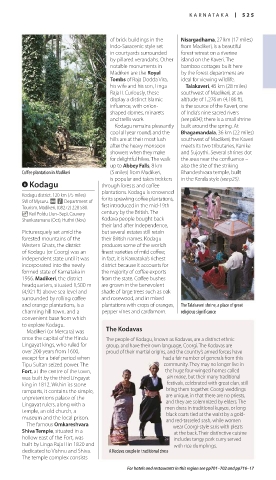
and orange plantations, is a plan tations with crops of oranges, The Talakaveri shrine, a place of great
charming hill town, and a pepper vines and cardamom. religious significance
convenient base from which
to explore Kodagu.
Madikeri (or Mercara) was The Kodavas
once the capital of the Hindu The people of Kodagu, known as Kodavas, are a distinct ethnic
Lingayat kings, who ruled for group, and have their own language, Coorgi. The Kodavas are
over 200 years from 1600, proud of their martial origins, and the country’s armed forces have
except for a brief period when had a fair number of generals from this
Tipu Sultan seized power. The community. They may no longer live in
Fort, at the centre of the town, the huge four-winged homes called
was built by the third Lingayat ain mane, but their many traditional
king in 1812. Within its stone festivals, celebrated with great elan, still
ramparts, it contains the simple, bring them together. Coorgi weddings
unpretentions palace of the are unique, in that there are no priests,
and they are solemnized by elders. The
Lingayat rulers, along with a men dress in traditional kupyas, or long
temple, an old church, a black coats tied at the waist by a gold-
museum and the local prison. and red-tasseled sash, while women
The famous Omkareshvara wear Coorgi-style saris with pleats
Shiva Temple, situated in a at the back. Their distinctive cuisine
hollow east of the Fort, was includes tangy pork curry served
built by Linga Raja II in 1820 and with rice dumplings.
dedicated to Vishnu and Shiva. A Kodava couple in traditional dress
The temple complex consists
For hotels and restaurants in this region see pp701–702 and pp716–17
524-525_EW_India.indd 525 26/04/17 11:55 am

