


Page 529 - (DK Eyewitness) Travel Guide - India
P. 529
K ARNA T AK A 527
0 Belur
Hassan district. 17 km (11 miles) SW of
Halebid. £ Hassan, 34 km (21 miles)
SE of town centre, then bus or taxi. @
n Tourist Office, (08177) 222 209.
One of the jewels of South
Indian architecture, Belur’s
Chennakeshava Temple was
built in 1117 by Vishnu vardhan
to commemorate the Hoysala
triumph over the Cholas
(see pp50–51). At the end of the
A columned Nandi pavilion in the Hoysaleshvara Temple, Halebid town’s main street, a towered
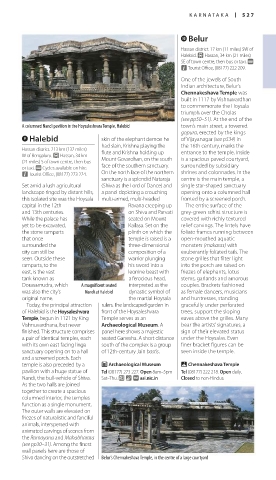
gopura, erected by the kings
9 Halebid skin of the elephant demon he of Vijayanagar (see p534) in
had slain, Krishna playing the the 16th century, marks the
Hassan district. 213 km (132 miles)
W of Bengaluru. £ Hassan, 34 km flute and Krishna holding up entrance to the temple. Inside
(21 miles) S of town centre, then bus Mount Govardhan, on the south is a spacious paved courtyard,
or taxi. @ Cycles available on hire. face of the southern sanctuary. surrounded by subsidiary
n Tourist Office, (08177) 273 224. On the north face of the northern shrines and colonnades. In the
sanctuary is a splendid Nataraja centre is the main temple, a
Set amid a lush agricultural (Shiva as the Lord of Dance) and single star-shaped sanctuary
landscape ringed by distant hills, a panel depicting a crouching opening onto a columned hall
this isolated site was the Hoysala multi-armed, multi-headed fronted by a screened porch.
capital in the 12th Ravana creeping up The entire surface of the
and 13th centuries. on Shiva and Parvati grey-green schist structure is
While the palace has seated on Mount covered with richly textured
yet to be excavated, Kailasa. Set on the relief carvings. The lintels have
the stone ramparts plinth on which the foliate frames running between
that once temple is raised is a open-mouthed aquatic
surrounded the three-dimensional monsters (makaras) with
city can still be composition of a exuberantly foliated tails. The
seen. Outside these warrior plunging stone grilles that filter light
ramparts, to the his sword into a into the porch are raised on
east, is the vast leonine beast with friezes of elephants, lotus
tank known as a ferocious head, stems, garlands and amorous
Dorasamudra, which A magnificent seated interpreted as the couples. Brackets fashioned
was also the city’s Nandi at Halebid dynastic symbol of as female dancers, musicians
original name. the martial Hoysala and huntresses, standing
Today, the principal attraction rulers. The landscaped garden in gracefully under perforated
of Halebid is the Hoysaleshvara front of the Hoysaleshvara trees, support the sloping
Temple, begun in 1121 by King Temple serves as an eaves above the grilles. Many
Vishnuvardhana, but never Archaeological Museum. A bear the artists’ signatures, a
finished. This structure comprises panel here shows a majestic sign of their elevated status
a pair of identical temples, each seated Ganesha. A short distance under the Hoysalas. Even
with its own east-facing linga south of the complex is a group finer bracket figures can be
sanctuary opening on to a hall of 12th-century Jain bastis. seen inside the temple.
and a screened porch. Each
temple is also preceded by a E Archaeological Museum Chennakeshava Temple
pavilion with a huge statue of Tel (08177) 273 227. Open 8am–5pm Tel (08177) 222 218. Open daily.
Nandi, the bull-vehicle of Shiva. Sat–Thu. ^ & ∑ asi.nic.in Closed to non-Hindus.
As the two halls are joined
together to create a spacious
columned interior, the temples
function as a single monument.
The outer walls are elevated on
friezes of naturalistic and fanciful
animals, interspersed with
animated carvings of scenes from
the Ramayana and Mahabharata
(see pp30–31). Among the finest
wall panels here are those of
Shiva dancing on the outstretched Belur’s Chennakeshava Temple, in the centre of a large courtyard
526-527_EW_India.indd 527 26/04/17 11:48 am

