


Page 530 - (DK Eyewitness) Travel Guide - India
P. 530
528 SOUTHWESTERN INDIA
Hoysala Art and Architecture
The temples of the Hoysala kings (12th–13th centuries) and their powerful ministers
are among the wonders of South Indian art and architecture. They embody a fusion of
the curving towers (shikharas) of North India with the columned mandapas of the south,
and are characterized by their unique star-shaped plan and their rich surface decoration.
The dense imagery of the basement friezes and wall panels, sculpted with religious
and mythological scenes, as well as the exquisite bracket figures, are fashioned
out of grey-green schist, a material that permits beautifully intricate carving.
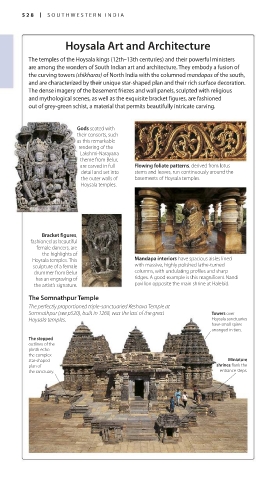
Gods seated with
their consorts, such
as this remarkable
rendering of the
Lakshmi-Narayana
theme from Belur,
are carved in full Flowing foliate patterns, derived from lotus
detail and set into stems and leaves, run continuously around the
the outer walls of basements of Hoysala temples.
Hoysala temples.
Bracket figures,
fashioned as beautiful
female dancers, are
the highlights of
Hoysala temples. This Mandapa interiors have spacious aisles lined
sculpture of a female with massive, highly polished lathe-turned
drummer from Belur columns, with undulating profiles and sharp
has an engraving of ridges. A good example is this magnificent Nandi
the artist’s signature. pavilion opposite the main shrine at Halebid.
The Somnathpur Temple
The perfectly proportioned triple-sanctuaried Keshava Temple at
Somnathpur (see p520), built in 1268, was the last of the great Towers over
Hoysala temples. Hoysala sanctuaries
have small spires
arranged in tiers.
The stepped
outlines of the
plinth echo
the complex
star-shaped Miniature
plan of shrines flank the
the sanctuary. entrance steps.
528-529_EW_India.indd 528 26/04/17 11:48 am
Eyewitness Travel LAYERS PRINTED:
Catalogue template “UK” LAYER
(Source v2.6)
Date 12th July 2013
Size 125mm x 217mm

