


Page 54 - (DK Eyewitness) Travel Guide - India
P. 54
52 INTRODUCING INDIA
The Coming of Islam (1206–1555) His successors included Iltutmish and Balban
Constant internal warfare between the (see p97). Next came the Khiljis (1290–1320),
different kingdoms, in the north as well whose ruler Alauddin conquered Gujarat,
as the south, had left them vulnerable to Rajasthan and Bengal, and made the kings of
outside attack. From the 11th century, a the Deccan and South India his tributaries.
volatile political situation in Central Asia, After the Khiljis came the Tughluqs (1320–
coupled with tales of India’s fabulous 1414), whose second ruler, Muhammad bin
wealth, fuelled a new wave of invasions Tughluq, completed the conquest of the
by Muslim Turkic rulers from the northwest. Deccan (see p479) and South India, and
Many of them stayed on in India annexed them. But he was unable to
to found dynasties, and maintain control over these distant areas,
with them came soldiers, which soon began to reassert their indepen
scholars and merchants, dence. This process was accelerated by the
as well as artists and Sufi devastating invasion of northern India by
preachers, who brought Timur of Samarkand in 1398, which further
new ideas in art, weakened the power of the Delhi Sultans.
architecture, theology The last two Sultanate dynasties, the
Ceramic tile detail, and warfare from the Islamic Sayyids (1413–1451) and the Lodis
Lodi period
world. These were to have a (1451–1526), were riven by infighting
lasting impact on religion, art, culture and among their nobles, and had only a
history in the Indian subcontinent. tenuous hold over their territories.
The first major invader was Mahmud
of Ghazni, who raided India repeatedly Independent Kingdoms
between 998–1030, and took back vast During the early years of the Delhi Sultans,
wealth from its defeated rulers. He was a number of independent kingdoms, such
followed by Muhammad of Ghur, who as the Solankis in Gujarat, the Eastern
conquered Punjab and Delhi, and Gangas in Odisha, and the Kakatiyas,
established his control over areas earlier Pandyas and Hoysalas of the Deccan and
dominated by Rajputs, after defeating South India had been absorbed into
Prithviraj Chauhan in 1192. He was the Sultanate. However, as the
succeeded by his slave, Tughluqs began to
Qutbuddin Aibak (1206– decline, many
1210), who founded the new independent
first of many Muslim states emerged.
dynasties, collecti vely The Hindu
known as the Delhi Vijayanagar Empire
Sultanate. Qutbuddin (see pp534–5) in
built the towering southern India
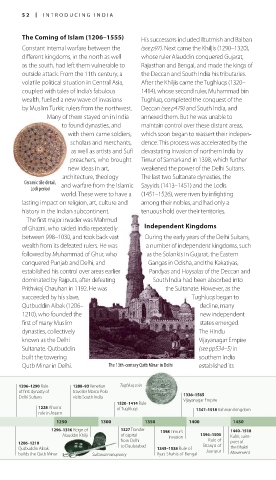
Qutb Minar in Delhi. The 13th-century Qutb Minar in Delhi established its
1206–1290 Rule 1288–93 Venetian Tughluq coin
of first dynasty of traveller Marco Polo
Delhi Sultans visits South India 1336–1565
Vijayanagar Empire
1320–1414 Rule
1228 Ahoms of Tughluqs 1347–1518 Bahmani kingdom
rule in Assam
1250 1300 1350 1400 1450
1296–1316 Reign of 1327 Transfer 1398 Timur’s 1440–1518
Alauddin Khilji of capital invasion 1394–1505 Kabir, saint
from Delhi Rule of
1206–1210 to Daulatabad Sharqis of poet of
Qutbuddin Aibak 1345–1538 Rule of Jaunpur the Bhakti
builds the Qutb Minar Sultanate weaponry Ilyas Shahis of Bengal Movement
052-053_EW_India.indd 52 26/04/17 11:42 am
Eyewitness Travel LAYERS PRINTED:
History Portrait template “UK” LAYER
(Source v1.2)
Date 20th August 2012
Size 125mm x 217mm

