


Page 57 - (DK Eyewitness) Travel Guide - India
P. 57
THE HIST OR Y OF INDIA 55
Nur Jahan
A formidable
combination of
brains and beauty,
Jahangir’s Persian-
born queen
(b.1577) was the
real power behind
the throne.
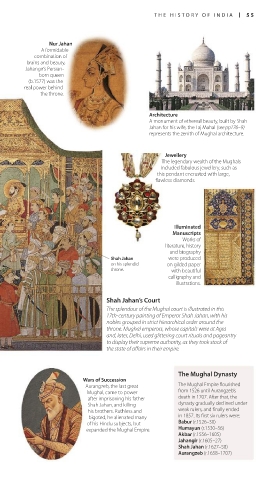
Architecture
A monument of ethereal beauty, built by Shah
Jahan for his wife, the Taj Mahal (see pp176–9)
represents the zenith of Mughal architecture.
Jewellery
The legendary wealth of the Mughals
included fabulous jewellery, such as
this pendant encrusted with large,
flawless diamonds.
Illuminated
Manuscripts
Works of
literature, history
and biography
Shah Jahan were produced
on his splendid on gilded paper
throne. with beautiful
calligraphy and
illustrations.
Shah Jahan’s Court
The splendour of the Mughal court is illustrated in this
17th-century painting of Emperor Shah Jahan, with his
nobles grouped in strict hierarchical order around the
throne. Mughal emperors, whose capitals were at Agra
and, later, Delhi, used glittering court rituals and pageantry
to display their supreme authority, as they took stock of
the state of affairs in their empire.
The Mughal Dynasty
Wars of Succession
Aurangzeb, the last great The Mughal Empire flourished
Mughal, came to power from 1526 until Aurangzeb’s
after imprisoning his father death in 1707. After that, the
Shah Jahan, and killing dynasty gradually declined under
his brothers. Ruthless and weak rulers, and finally ended
bigoted, he alienated many in 1857. Its first six rulers were:
of his Hindu subjects, but Babur (r.1526–30)
expanded the Mughal Empire. Humayun (r.1530–56)
Akbar (r.1556–1605)
Jahangir (r.1605–27)
Shah Jahan (r.1627–58)
Aurangzeb (r.1658–1707)
054-055_EW_India.indd 55 26/04/17 11:42 am

