


Page 55 - (DK Eyewitness) Travel Guide - India
P. 55
THE HIST OR Y OF INDIA 53
independence in 1336, while developed at places such as
the Muslim kingdom of the Ahmedabad, Mandu, and the
Bahmani sultans was founded Muslim kingdoms of the Deccan.
in 1347 in the Deccan, by a In religion, mystical Sufi sects
Tughluq noble. By the early 16th and saint-poets of the Bhakti
century, the Bahmani kingdom Movement, such as Meerabai and
had broken up into the five Kabir, popularized the practice
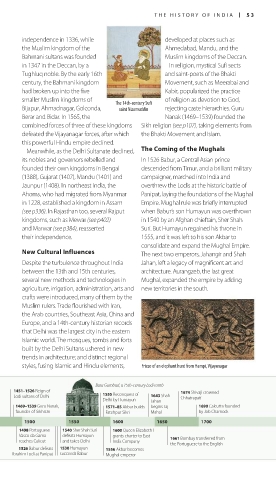
smaller Muslim kingdoms of The 14th-century Sufi of religion as devotion to God,
Bijapur, Ahmadnagar, Golconda, saint Nizamuddin rejecting caste hierarchies. Guru
Berar and Bidar. In 1565, the Nanak (1469–1539) founded the
combined forces of three of these kingdoms Sikh religion (see p107), taking elements from
defeated the Vijayanagar forces, after which the Bhakti Movement and Islam.
this powerful Hindu empire declined.
Meanwhile, as the Delhi Sultanate declined, The Coming of the Mughals
its nobles and governors rebelled and In 1526 Babur, a Central Asian prince
founded their own kingdoms in Bengal descended from Timur, and a brilliant military
(1388), Gujarat (1407), Mandu (1401) and campaigner, marched into India and
Jaunpur (1408). In northeast India, the overthrew the Lodis at the historic battle of
Ahoms, who had migrated from Myanmar Panipat, laying the foundations of the Mughal
in 1228, established a kingdom in Assam Empire. Mughal rule was briefly interrupted
(see p336). In Rajasthan too, several Rajput when Babur’s son Humayun was overthrown
kingdoms, such as Mewar (see p402) in 1540 by an Afghan chieftain, Sher Shah
and Marwar (see p384), reasserted Suri. But Humayun regained his throne in
their independence. 1555, and it was left to his son Akbar to
consolidate and expand the Mughal Empire.
New Cultural Influences The next two emperors, Jahangir and Shah
Despite the turbulence throughout India Jahan, left a legacy of magnificent art and
between the 13th and 15th centuries, architecture. Aurangzeb, the last great
several new methods and technologies in Mughal, expanded the empire by adding
agriculture, irrigation, administration, arts and new territories in the south.
crafts were introduced, many of them by the
Muslim rulers. Trade flourished with Iran,
the Arab countries, Southeast Asia, China and
Europe, and a 14th-century historian records
that Delhi was the largest city in the eastern
Islamic world. The mosques, tombs and forts
built by the Delhi Sultans ushered in new
trends in architec ture; and distinct regional
styles, fusing Islamic and Hindu elements, Frieze of an elephant hunt from Hampi, Vijayanagar
Bara Gumbad, a 15th-century Lodi tomb
1451–1526 Reign of 1674 Shivaji crowned
Lodi sultans of Delhi 1555 Reconquest of 1643 Shah Chhatrapati
Delhi by Humayun Jahan
1469–1539 Guru Nanak, 1571–85 Akbar builds begins Taj 1690 Calcutta founded
founder of Sikhism Fatehpur Sikri Mahal by Job Charnock
1450 1500 1550 1600 1650 1700
1498 Portuguese 1540 Sher Shah Suri 1600 Queen Elizabeth I
Vasco da Gama defeats Humayun grants charter to East
reaches Calicut and takes Delhi India Company 1661 Bombay transferred from
the Portuguese to the English
1526 Babur defeats 1530 Humayun 1556 Akbar becomes
Ibrahim Lodi at Panipat succeeds Babur Mughal emperor
052-053_EW_India.indd 53 26/04/17 11:42 am

