


Page 58 - (DK Eyewitness) Travel Guide - India
P. 58
56 INTRODUCING INDIA
The Decline of the Mughals adjac ent enclaves. The Dutch, in
The death of Emperor Aurangzeb, turn, lost out to the English. The
the last great Mughal, in 1707, 18th century saw major conflicts
heralded the decline of the between the French and
Mughal Empire. He left a ruined English, with three Carnatic
economy and weak successors, Wars fought between 1740
and independent states now and 1763, in South India and
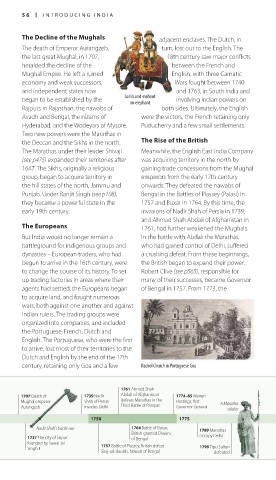
began to be est ablished by the Sahib and mahout involving Indian powers on
on elephant
Rajputs in Rajasthan, the nawabs of both sides. Ultimately, the English
Avadh and Bengal, the nizams of were the victors, the French retaining only
Hyderabad, and the Wodeyars of Mysore. Puducherry and a few small settlements.
Two new powers were the Marathas in
the Deccan and the Sikhs in the north. The Rise of the British
The Marathas under their leader Shivaji Meanwhile, the English East India Company
(see p475) expan ded their territories after was acquiring territory in the north by
1647. The Sikhs, originally a religious gaining trade concessions from the Mughal
group, began to acquire territory in emperors from the early 17th century
the hill states of the north, Jammu and onwards. They defeated the nawabs of
Punjab. Under Ranjit Singh (see p108), Bengal in the Battles of Plassey (Palasi) in
they became a powerful state in the 1757 and Buxar in 1764. By this time, the
early 19th century. invasions of Nadir Shah of Persia in 1739,
and Ahmad Shah Abdali of Afghanistan in
The Europeans 1761, had further weakened the Mughals.
But India would no longer remain a In the battle with Abdali the Marathas,
battleground for indigenous groups and who had gained control of Delhi, suff ered
dynasties – European traders, who had a crushing defeat. From these beginnings,
begun to arrive in the 16th century, were the British began to expand their power.
to change the course of its history. To set Robert Clive (see p565), responsible for
up trading factor ies in areas where their many of their successes, became Governor
agents had settled, the Europeans began of Bengal in 1757. From 1773, the
to acquire land, and fought numerous
wars, both against one another and against
Indian rulers. The trading groups were
organized into companies, and included
the Portuguese, French, Dutch and
English. The Portuguese, who were the first
to arrive, lost most of their territories to the
Dutch and English by the end of the 17th
century, retaining only Goa and a few Rachol Church in Portuguese Goa
1761 Ahmed Shah
1707 Death of 1739 Nadir Abdali of Afghanistan 1774–85 Warren
Mughal emperor Shah of Persia defeats Marathas in the Hastings, first A Maratha
Aurangzeb invades Delhi Third Battle of Panipat Governor General
soldier
1750 1775
Nadir Shah’s battle axe 1764 Battle of Buxar, 1789 Marathas
British granted Diwani
1727 The city of Jaipur of Bengal occupy Delhi
founded by Sawai Jai 1757 Battle of Plassey, British defeat
Singh II 1799 Tipu Sultan
Siraj-ud-daulah, Nawab of Bengal defeated
056-057_EW_India.indd 56 26/04/17 11:42 am
Eyewitness Travel LAYERS PRINTED:
History Portrait template “UK” LAYER
(Source v1.2)
Date 20th August 2012
Size 125mm x 217mm

