


Page 60 - (DK Eyewitness) Travel Guide - India
P. 60
58 Introduc I ng Ind I a
Pax Britannica
the foundations of British rule, or the raj, were laid
after the Indian Mutiny of 1857, which revealed the Delhi Gwalior
unpopularity of the East India company’s rule. By an Jaipur Calcutta
act of Parliament in 1858, the company’s rule ended, (Kolkata)
Bombay
and its Indian territories became part of the British (Mumbai) Madras
Empire, to be ruled through a viceroy. though the (Chennai)
raison d’être of the raj was economic profit and
political control, its abiding legacy was the political British India
unification of the subcontinent, together with the
introduction of Western education, a centralized British territory, 1858
administrative system, and a network of railways.
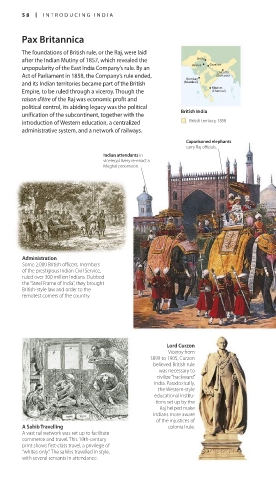
Caparisoned elephants
carry Raj officials.
Indian attendants in
viceregal livery re-enact a
Mughal procession.
Administration
Some 2,000 British officers, members
of the prestigious Indian Civil Service,
ruled over 300 million Indians. Dubbed
the “Steel Frame of India”, they brought
British-style law and order to the
remotest corners of the country.
Lord Curzon
Viceroy from
1899 to 1905, Curzon
believed British rule
was necessary to
civilize “backward”
India. Paradoxically,
the Western-style
educational institu-
tions set up by the
Raj helped make
Indians more aware
of the injustices of
A Sahib Travelling colonial rule.
A vast rail network was set up to facilitate
commerce and travel. This 19th-century
print shows first-class travel, a privilege of
“whites only”. The sahibs travelled in style,
with several servants in attendance.
058-IND-AT509-1388-Hist8.indd 58 29/04/14 7:08 pm

