


Page 600 - (DK Eyewitness) Travel Guide - India
P. 600
598 SOUTH INDIA
can be a magical experience.
Also in the town is the 9th-
century Panchanandishvara
Temple (“Lord of the Five Rivers”),
built by the Cholas. Dedicated
to Shiva, the shrines of Uttara
(north) Kailasha and Dakshina
(south) Kailasha, on either side
of the main temple, were built
by the wives of Rajaraja I and
Rajendra I (see pp50–51). The
temple’s huge prakara (boundary)
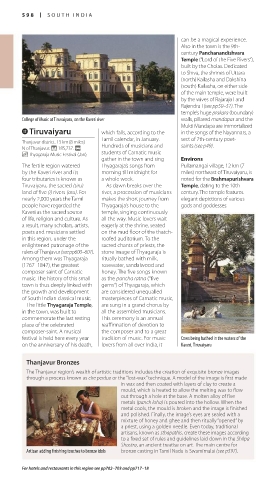
College of Music at Tiruvaiyaru, on the Kaveri river walls, pillared mandapas and the
Mukti Mandapa are immor talized
w Tiruvaiyaru which falls, according to the in the songs of the Nayannars, a
Tamil calendar, in January. sect of 7th-century poet-
Thanjavur district. 13 km (8 miles)
N of Thanjavur. * 185,737. @ Hundreds of musicians and saints (see p49).
_ Thyagaraja Music Festival (Jan). students of Carnatic music
gather in the town and sing Environs
The fertile region watered Thyagaraja’s songs from Pullamangai village, 12 km (7
by the Kaveri river and its morning till midnight for miles) northeast of Tiruvaiyaru, is
four tributaries is known as a whole week. noted for the Brahmapurishvara
Tiru vaiyaru, the sacred (tiru) As dawn breaks over the Temple, dating to the 10th
land of five (i) rivers (aru). For river, a procession of musicians century. The temple features
nearly 2,000 years the Tamil makes the short journey from elegant depictions of various
people have regarded the Thyagaraja’s house to the gods and goddesses.
Kaveri as the sacred source temple, singing contin uously
of life, religion and culture. As all the way. Music lovers wait
a result, many scholars, artists, eagerly at the shrine, seated
poets and musicians settled on the mud floor of the thatch-
in this region, under the roofed auditorium. To the
enlightened patronage of the sacred chants of priests, the
rulers of Thanjavur (see pp600–601). stone image of Thyagaraja is
Among them was Thyagaraja ritually bathed with milk,
(1767–1847), the greatest rosewater, sandalwood and
composer-saint of Carnatic honey. The five songs known
music. The history of this small as the pancha ratna (“five
town is thus deeply linked with gems”) of Thyagaraja, which
the growth and development are considered unequalled
of South Indian classical music. masterpieces of Carnatic music,
The little Thyagaraja Temple, are sung in a grand chorus by
in the town, was built to all the assembled musicians.
commemorate the last resting This ceremony is an annual
place of the celebrated reaffirmation of devotion to
composer-saint. A musical the composer and to a great
festival is held here every year tradition of music. For music Cows being bathed in the waters of the
on the anniversary of his death, lovers from all over India, it Kaveri, Tiruvaiyaru
Thanjavur Bronzes
The Thanjavur region’s wealth of artistic traditions includes the creation of exquisite bronze images
through a process known as cire perdue or the “lost-wax” technique. A model of the image is first made
in wax and then coated with layers of clay to create a
mould, which is heated to allow the melting wax to flow
out through a hole at the base. A molten alloy of five
metals (panch loha) is poured into the hollow. When the
metal cools, the mould is broken and the image is finished
and polished. Finally, the image’s eyes are sealed with a
mixture of honey and ghee and then ritually “opened” by
a priest, using a golden needle. Even today, traditional
artisans, known as sthapathis, create these images according
to a fixed set of rules and guidelines laid down in the Shilpa
Shastra, an ancient treatise on art. The main centre for
Artisan adding finishing touches to bronze idols bronze casting in Tamil Nadu is Swamimalai (see p597).
For hotels and restaurants in this region see pp702–703 and pp717–18
598-599_EW_India.indd 598 26/04/17 11:49 am
Eyewitness Travel LAYERS PRINTED:
Catalogue template “UK” LAYER
(Source v2.6)
Date 12th July 2013
Size 125mm x 217mm

