


Page 599 - (DK Eyewitness) Travel Guide - India
P. 599
T A MIL NADU 597
was held in 2016). At the
auspicious time, thousands
of devotees enter the tank for
their holy dip. This is when the
purifying power of the water
is said to be at its height. The
devout believe that all of India’s
nine sacred rivers (Ganges,
Yamuna, Saraswati, Sarayu,
Godavari, Narmada, Kaveri,
Payokshini and Kanniyakumari)
also bathe in the tank to cleanse
themselves of the sins of
humanity accumulated in
their waters.
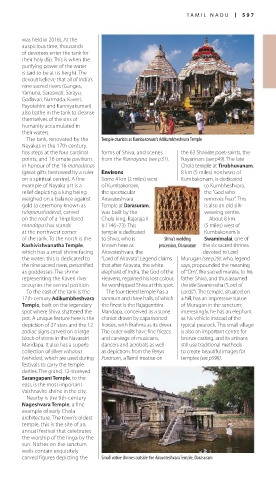
The tank, renovated by the Temple chariots at Kumbakonam’s Adikumbheshvara Temple
Nayakas in the 17th century,
has steps at the four cardinal forms of Shiva, and scenes the 63 Shaivite poet-saints, the
points, and 16 ornate pavilions from the Ramayana (see p31). Nayannars (see p49). The late
in honour of the 16 mahadanas Chola temple at Tirubhuvanam,
(great gifts bestowed by a ruler Environs 8 km (5 miles) northeast of
on a spiritual centre). A fine Some 4 km (2 miles) west Kumbakonam, is dedicated
example of Nayaka art is a of Kumbakonam, to Kumbheshvara,
relief depicting a king being the spectacular the “God who
weighed on a balance against Airavateshvara removes Fear”. This
gold (a ceremony known as Temple at Darasuram, is also an old silk-
tulapurushadeva), carved was built by the weaving centre.
on the roof of a 16-pillared Chola king, Rajaraja II About 8 km
mandapa that stands (r.1146–73). This (5 miles) west of
at the northwest corner temple is dedicated Kumbakonam is
of the tank. To the north is the to Shiva, who is Shiva’s wedding Swamimalai, one of
Kashi vishvanatha Temple, known here as procession, Darasuram the six sacred shrines
which has a small shrine facing Airavateshvara, the devoted to Lord
the water; this is dedicated to “Lord of Airavata”. Legend claims Murugan (see p29), who, legend
the nine sacred rivers, personified that after Airavata, the white says, propounded the meaning
as goddesses. The shrine elephant of Indra, the God of the of “Om”, the sacred mantra, to his
representing the Kaveri river Heavens, regained his lost colour, father Shiva, and thus assumed
occupies the central position. he worshipped Shiva at this spot. the title Swaminatha (“Lord of
To the east of the tank is the The four-tiered temple has a Lords”). The temple, situated on
17th-century Adikumbh eshvara sanctum and three halls, of which a hill, has an impressive statue
Temple, built on the legendary the finest is the Raja gambira of Murugan in the sanctum;
spot where Shiva shattered the Mandapa, conceived as a stone interestingly, he has an elephant
pot. A unique feature here is the chariot drawn by caparisoned as his vehicle instead of the
depiction of 27 stars and the 12 horses, with Brahma as its driver. typical peacock. This small village
zodiac signs carved on a large The out er walls have fine friezes is also an important centre for
block of stone in the Navaratri and carvings of musicians, bronze casting, and its artisans
Mandapa. It also has a superb dancers and acrobats as well still use traditional methods
collection of silver vahanas as depictions from the Periya to create beautiful images for
(vehicles), which are used during Puranam, a Tamil treatise on temples (see p598).
festivals to carry the temple
deities. The grand, 12-storeyed
Sarangapani Temple, to the
east, is the most important
Vaishnavite shrine in the city.
Nearby is the 9th-century
Nageshvara Temple, a fine
example of early Chola
architecture. The town’s oldest
temple, this is the site of an
annual festival that celebrates
the worship of the linga by the
sun. Niches on the sanctum
walls contain exquisitely
carved figures depicting the Small votive shrines outside the Airavateshvara Temple, Darasuram
596-597_EW_India.indd 597 26/04/17 11:49 am

